
The MAGA Shockwave: How Donald Trump’s nationalist agenda is rewriting the global order and setting up a volatile future!
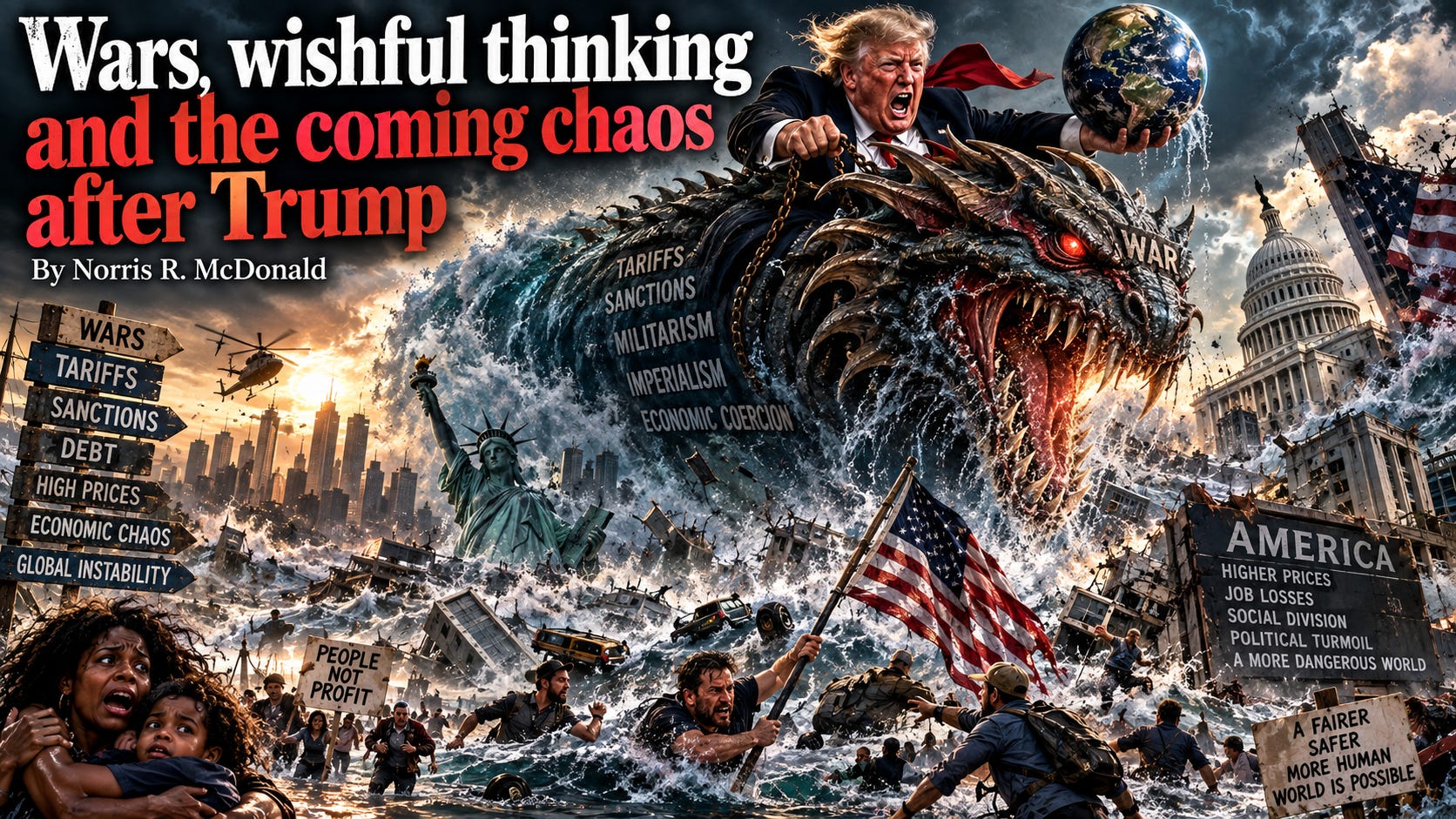
By Norris R. McDonald

When great powers play geopolitical chess, ordinary people become the pawns—and when the bombs stop falling, the bills do not.
That is the uncomfortable lesson of an increasingly dangerous world in which military power, economic coercion and geopo

litical rivalry collide with the everyday struggle for economic survival.
The United States and its allies still possess enormous military, financial and diplomatic power, but that power has limits. As American dominance faces growing challenges abroad and contradictions at home, Washington and its allies increasingly rely on tariffs, sanctions, military alliances and long-range weapons to preserve their influence.
Donald Trump has added a particularly volatile dimension through his nationalist agenda, aggressive tariff policies and willingness to confront allies and adversaries alike.
WARS AND THE POLITICS OF WISHFUL THINKING
Trump, however, did not create these contradictions. He accelerated them. The crisis is larger than one president or political party. It reflects a global system increasingly using military power and economic dominance to defend strategic interests while ordinary people absorb the costs.
The Russia-Ukraine war, now sustained by massive Western military support for Kyiv, illustrates these dangers. Western countries possess extraordinary military capabilities, but recent history demonstrates that military superiority does not automatically produce durable political outcomes.
Afghanistan, Iraq and Libya showed the enormous difference between destroying military targets and achieving lasting political objectives.
Russia presents an even more dangerous challenge. It is a nuclear-armed great power with substantial military capabilities, strategic depth and significant escalation options.
The question is not whether Western militaries are powerful—they unquestionably are—but whether military pressure can produce the desired political outcome without creating consequences more dangerous than the original objective.
ANDY BURNHAM AND EUROPEAN HUBRIS
That concern has become more pronounced with Britain’s expanding military support for Ukraine. Prime Minister Andy Burnham authorized actions concerning British components used in the SCALP/Storm Shadow missile system to facilitate greater Ukrainian capacity to produce long-range weapons.

Moscow responded with explicit threats to strike British military targets in response to Ukrainian attacks involving British-supplied long-range weapons. Whatever one’s view of Britain’s support for Ukraine, such exchanges can widen the circle of states Moscow regards as directly involved and increase the danger that a war already consuming Ukraine could spread beyond its borders.
This is the danger of geopolitical escalation. Each additional step is presented as necessary and controlled, yet their cumulative effect can erase the boundary between indirect involvement and direct confrontation. Eventually, governments may create consequences their architects can no longer control.
WHO ULTIMATELY PAYS?
Governments authorize billions of dollars in military spending while defence industries receive enormous contracts, and political leaders invoke national security. Ordinary people experience these conflicts through the price of food, transportation, electricity, rent and other necessities.
Wars disrupt energy markets, shipping routes, commodity supplies and international trade. Sanctions, tariffs and countersanctions can alter supply chains and increase import, transportation and production costs.
Wealthier countries have greater capacity to absorb these shocks. Smaller developing economies carrying significant debt and depending heavily on imports have far less room to manoeuvre.
That is why Jamaica cannot regard distant wars as somebody else’s problem. We import energy, food, manufactured goods, machinery and other essentials.
When shipping becomes more expensive, commodity prices rise or international uncertainty increases, the consequences eventually reach Jamaican households. The battlefield may be thousands of miles away, but the economic consequences are not.
THE POOR PAY THE BILL
The working class understands something political elites too often forget somebody eventually has to pay the bill.
Small farmers, artisans, daily-wage workers, pensioners, low-income families and the struggling middle class cannot command military alliances or negotiate trillion-dollar trade agreements. They absorb the consequences through reduced purchasing power and higher household costs.

Here lies a fundamental political contradiction. Governments can mobilize enormous resources when they declare a geopolitical emergency, yet ordinary citizens are repeatedly told that affordable housing, healthcare, education and stronger social protection must wait because there is insufficient money.
If governments can find billions for military priorities, why is comparable urgency so difficult to summon when people face housing, food and healthcare crises?
That is not merely an economic question. It is a question of political priorities.
BREAD-AND-BUTTER ISSUES AND THE CHAOS AFTER TRUMP
This is why bread-and-butter politics matters.
People want to know that they will be able to afford a decent home. They care about their children’s future and the need for good quality education. The rising cost of healthcare and prescription drugs are creating financial ruin. And this demand urgent solutions. Overall, wages must pace with living costs thereby allowing the working class to not only put food on the table but satisfy other basic needs.
In the end Donald Trump will eventually, unceremoniously, leave office. But the frustrations of the working class that he exploited with rampant racism and aggressive nationalism, will still confront America and demand urgent solutions.

The political turbulences created by Trump’s warmongering and virulent policies most certainly cannot be solved by a change of face to a Democratic or Republican politician who may be just as warmongering as he is.
Poor people and the middle class are exhausted. A stronger alternative begins with a different understanding of national power. A strong society is one in which people can afford to live with dignity, and a strong country is one in which families are not destroyed by food prices, housing costs, medical bills and insecure employment.
Maybe that’s why New York City Mayor Zohran Mamdani, Angie Nixon, Dr. Abdul Sayed, and other democratic socialists are scoring political successes. It is not about political rhetoric. It is about practical policies that eliminate hunger, homelessness, poor health, decrepit schools and inferior education.
Great power leaders can wave their oppressive flag of imperialism as high as they want. But they cannot hide the excruciating hunger of mothers and children belly pain.
In the end, people will judge their governments by the most basic measure of all: Can we afford to live and survive on scraps and handouts?
That is just the bitta truth.
About the Author
Norris R. McDonald is an author, respiratory therapist, and economic journalist whose work focuses on political economy, public health, healthcare systems, and global public policy. He is a regular contributor of public commentary and analysis for the Jamaica Gleaner, where he examines the intersection of economics, governance, social justice, and development in Jamaica, the Caribbean, and the Global South.
RESOURCES:


