Showing posts with label Norris R McDonald Books. Show all posts

Monday, February 23, 2026

PennyMac Financial Services Faces Allegations of Mortgage Abuse and Unfair Lending Practices

Sulfabittas News reports on major Caribbean political developments affecting Jamaica and the wider region.

PennyMac Escrow Account Shortages: What Borrowers Should Watch For in 2026 And How to Fight Back!

An escrow shortage happens when the money collected in your mortgage escrow account isn’t enough to cover property taxes or homeowners insurance. If you have a loan serviced by Pennymac, a shortage can increase your monthly mortgage payment because the lender must recover the shortfall and adjust future escrow contributions.  
Escrow shortages are usually caused by rising property taxes, higher insurance premiums, or prior underestimates—not necessarily servicing errors—but homeowners should always review their escrow analysis carefully.

In the case of PennyMac they have never been able to sow how these claimed escrow shortages occurred.  This is very important at time when housing affordability is collapsing under rising interest rates and inflated property values, a new book is challenging the very foundation of the American mortgage system. In Unjust Enrichment: How PennyMac, Banks and Other Mortgage Companies Undermine Homeowners, Norris R. McDonald delivers a detailed investigation into the practices he argues continue to strip wealth from everyday homeowners.

This is not simply a critique of the 2008 housing collapse. Instead, the book connects past financial misconduct to modern mortgage servicing practices, alleging that institutions such as PennyMac, Bank of America, and the now-defunct Countrywide Financial helped shape a system where corporate profit often outweighs homeowner protection.

A System Built on Escrow Manipulation and Hidden Fees?

One of the most compelling sections of Unjust Enrichment examines escrow account shortages — a technical mortgage process that many borrowers barely understand until their monthly payments suddenly increase. McDonald argues that repeated escrow recalculations, fee assessments, and opaque servicing practices create financial strain that can push already vulnerable families toward default.

Rather than isolated mistakes, the book presents these incidents as part of a broader servicing culture that allegedly prioritizes revenue generation over transparency. For homeowners living paycheck to paycheck, even small unexplained increases can trigger cascading financial consequences.

The Foreclosure–Homelessness Pipeline

McDonald draws a direct line between aggressive foreclosure practices and rising housing instability across America. While public narratives often blame borrowers for default, Unjust Enrichment reframes the conversation by examining how servicing errors, disputed charges, and legal complexities can accelerate foreclosure timelines.The book suggests that wrongful or preventable foreclosures do more than displace families. They erode generational wealth, destabilize neighborhoods, and widen economic inequality. In cities already struggling with affordable housing shortages, each foreclosure can contribute to long-term community decline.

After the 2008 Crash — What Really Changed?

Following the housing market collapse, regulatory reforms promised stronger consumer protections and oversight. However, McDonald contends that while lending structures evolved, many servicing practices remained fundamentally unchanged.

By analyzing post-crisis consumer complaints, legal filings, and regulatory cases, Unjust Enrichment argues that patterns of aggressive fee collection, foreclosure processing shortcuts, and escrow volatility persisted long after the financial headlines faded.

The book challenges readers to reconsider whether the lessons of 2008 were fully learned — or simply repackaged.

Why This Book Is Trending Now


With mortgage rates fluctuating and housing inventory tightening, homeowners once again face mounting pressure. Economic uncertainty has amplified concerns about payment stability, property taxes, and insurance-driven escrow spikes. Against this backdrop, Unjust Enrichment resonates as both a warning and a guide.

Google Discover readers searching for insights on mortgage fraud, foreclosure protection, escrow shortages, and banking accountability are finding renewed interest in investigative works that unpack the hidden mechanics of home lending.

Empowering Homeowners With Knowledge

Beyond exposing alleged misconduct, McDonald emphasizes consumer empowerment. The book outlines practical steps homeowners can take to better understand their mortgage statements, monitor escrow calculations, and assert their rights under federal housing laws.

Rather than presenting homeowners as powerless victims, Unjust Enrichment positions financial literacy and regulatory awareness as critical tools in preserving homeownership and generational wealth.

A National Conversation About Housing Justice

At its core, Unjust Enrichment asks a fundamental question: Who benefits when homeowners lose?

By weaving together data, case studies, and policy analysis, Norris R. McDonald invites policymakers, financial professionals, housing advocates, and everyday borrowers to reexamine the structure of America’s mortgage system.

As debates over housing affordability and corporate accountability intensify, this book adds fuel to a conversation that is far from over.

The book serves as:

  • A financial watchdog resource
  • A consumer rights guide
  • A legal and policy reform blueprint
  • A wake-up call for homeowners nationwide


 How Homeowners Can Protect Themselves

Beyond exposing wrongdoing, Unjust Enrichment provides actionable solutions:

  • Understanding escrow statements and mortgage servicing rules
  • Monitoring payment changes and fee assessments
  • Knowing your legal rights under federal housing laws
  • Filing complaints with regulatory agencies
  • Advocating for mortgage transparency reform


Who Should Read This Book?

  • Homeowners and first-time buyers
  • Consumer protection advocates
  • Legal professionals
  • Housing policy experts
  • Financial educators
  • Journalists covering banking and foreclosure

If you care about housing justice, financial fairness, and protecting generational wealth, this book is essential read!

An alleged escrow shortage can occur when you mortgage servicer reports that they have not collected enough from monthly payments to cover property taxes, or homeowners insurance. However, this investigation discovered that PennyMac  has been very egregious in making escrow shortage claims.  This investigation reveals that is has now become a common practice  of PennyMac, even when property taxes did not go up or, insurance premiums dod not rise. 
  • Why did I get a shortage? It can happens if your property taxes increased, your homeowners insurance premium went up, or a previous escrow analysis was based on lower costs. If none of this occurred contact your mortgage servicer and demand an explanation. 
  • What options do I have?
    • Pay in Full: You can pay the total shortage amount immediately, which prevents your monthly payment from increasing.
    • Spread the Cost: The servicer will divide the shortage by 12 and add it to your monthly payments for the next year.
  • Will my monthly payment go up? Yes, usually. Even if you pay the shortage in full, a persistent rise in taxes or insurance means your base escrow payment for the coming year will likely be higher.
  • VIGILANCE Pay attention to the details of your mortgage statement and match current ones to previous statements, your property taxes and insurance charges. 


ABOUT THE AUTHOR

Norris R. McDonald is an author, respiratory therapist, and economic journalist specializing in political economy, public health, and healthcare policy. His work appears in the Jamaica Gleaner and on Sulfabittas Newsmagazine (Substack), focusing on social justice, Black culture, and global affairs.

Sunday, February 22, 2026

Corruption Is Economic Violence — And Jamaica Is Paying the Price

Sulfabittas News reports on major Caribbean political and global developments affecting Jamaica and the wider region.

Corruption as economic violence—class contrast and national consequences.

By Norris R. McDonald | SULFABITTAS NEWS

Jamaica may be recording a decline in murders, and that development is rightly welcomed. Any measurable reduction in violent deaths represents relief for families and communities that have endured decades of trauma. However, while public discourse remains focused on street-level criminality, the country continues to confront a deeper and more structurally destabilizing crisis: the persistent expansion of white-collar crime and the normalization of elite impunity.

A nation cannot meaningfully address crime if its concern is limited to the actions of the marginalized while large-scale financial irregularities proliferate within the upper reaches of the state and corporate sector. When procurement abuses are treated as administrative lapses rather than prosecutable offences, when investigations stretch across years without resolution, and when meaningful asset recovery remains rare, the problem transcends governance inefficiency. It becomes systemic economic harm.

A Dangerous Imbalance in National Attention

This contradiction should trouble every serious observer of Jamaica’s political economy. A society cannot confront crime while limiting its focus to the desperate and dispossessed, even as vast financial irregularities quietly multiply in the corridors of influence. When white-collar wrongdoing is absorbed into routine procedure, the country begins to misread its own danger, celebrating visible improvements while ignoring the deeper mechanisms that reproduce scarcity, inequality, and distrust.

Corruption as Economic Violence

Corruption should not be viewed merely as an ethical lapse or an unfortunate feature of political culture. It is better understood as a material process that redistributes wealth upward while eroding the state’s capacity to serve its citizens. Each inflated contract, each manipulated concession, and each unexplained budgetary overrun represents a transfer of collective resources into private hands. The cumulative impact of these transfers is borne not by the beneficiaries of corruption, but by ordinary Jamaicans who face deteriorating services and rising living costs.

The human cost: corruption manifests as hardship, weakened services, and rising costs.

This is why corruption constitutes a form of economic violence. It does not manifest in nightly crime reports, yet its consequences are visible in overcrowded classrooms, under-resourced clinics, unsafe roads, unreliable water supply, and persistent wage stagnation. These are not isolated failures of management; they are downstream effects of fiscal leakages that accumulate year after year.

The Asymmetry of Justice

The contrast between how street crime and white-collar crime are treated further compounds public frustration. Lower-income Jamaicans routinely face swift arrest and harsh punishment for minor infractions, while high-level financial irregularities often languish in extended audits and administrative reviews that rarely culminate in criminal convictions. This asymmetry sends a powerful social message about whose actions are considered intolerable and whose are negotiable.

Empirical evidence already illustrates the magnitude of the problem. In one recent fiscal year, Jamaica’s Auditor General flagged more than J$20 billion in procurement breaches, cost overruns, and unsupported payments across multiple ministries and public bodies. These findings represent only the portion of leakage that is formally documented. They do not capture sophisticated forms of under-invoicing, transfer pricing, inflated consultancy fees, or concessionary giveaways that escape routine audit processes. Yet despite the scale of these irregularities, criminal prosecutions remain rare, asset recovery even rarer, and administrative sanctions minimal. The signal transmitted to society is unmistakable: large-scale theft conducted through institutional channels carries little personal risk.

Disaster Recovery and the Politics of Reconstruction

The devastation caused by Hurricane Melissa in western Jamaica underscores the stakes involved in public financial management. Large-scale disasters require rapid mobilization of resources for reconstruction, infrastructure repair, and social support. Billions can be allocated within relatively short periods, creating both opportunity and risk. In an environment already strained by fiscal leakage, disaster recovery becomes a test of national integrity: whether funds will be spent transparently, competitively, and in the public interest.

The problem is not episodic. Over the past decade, cumulative audit reports and parliamentary oversight reviews have repeatedly identified tens of billions of Jamaican dollars in unresolved financial irregularities, ranging from abandoned capital projects to unexplained advances and persistently breached procurement rules. In this context, every new disaster allocation becomes vulnerable not only to logistical delay, but to absorption into an already porous fiscal architecture.

Corruption, Class, and Development

Corruption ultimately functions as a class-based economic distortion. It does not rely on overt coercion, yet it systematically disadvantages those with the least political access. Rising electricity rates, increased transport costs, higher food prices, and utility adjustments do not occur in isolation. They are frequently connected to structural inefficiencies and procurement practices that reflect deeper governance failures, with the poor and middle class effectively paying twice: once through taxation and again through diminished service quality.

Elite impunity: when accountability does not reach the conference room, development weakens.

Accountability as a Development Imperative

Reducing street violence remains essential, and progress achieved in that area should not be dismissed. However, any national crime strategy that excludes white-collar accountability is incomplete. Handcuffs cannot remain conceivable only in inner-city communities while boardrooms remain insulated from scrutiny. Equal enforcement of the law is not hostility to success; it is the foundation of legitimate development, credible governance, and democratic trust.

Ultimately, Jamaica’s future will not be determined solely by whether murders rise or fall in any given year. It will be determined by whether the society is willing to dismantle a political economy in which economic power routinely shields wrongdoing while poverty is criminalized. A country cannot tax its way out of corruption, nor can it police its way around elite impunity. Development requires more than growth targets and fiscal discipline; it requires a credible architecture of accountability that treats theft of public wealth as the serious crime it is. Until such an architecture is firmly established, the corruption economy will continue to drain national possibility, quietly but relentlessly, even as Jamaicans are asked to endure still more sacrifice in the name of stability.

Norris R. McDonald is an Author, Respiratory Therapist, and Economic Journalist who writes public commentary on political economy, public policy, and health systems, and publishes SULFABITTAS NEWS.

*******************

BLACK HISTORY BOOKS:

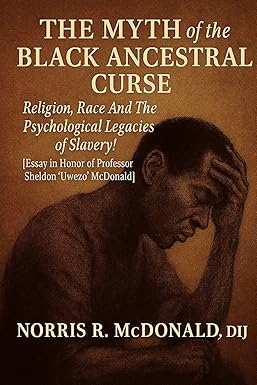
The Myth of the Black Ancestral Curse: Religion, Race, and the Psychological Legacy of Slavery!

by Norris R McDonald (Author)

Thursday, January 29, 2026

The Myth of the Black Ancestral Curse: How Religion Was Used To Justify Slavery!


Norris R. McDonald, DIJ CRT, Author, Economic Journalist & Human Rights Activist 

Myth of the Black Ancestral Curse is a critical study of  phycological legacies of slavery and the role religion and race plays in reenforcing racist stereotypes. 

This book:

  • Deconstructing the Curse of Ham, Colonial Lies, and the Struggle for Black Liberation
  • How Slavery, Religion, and Myth Created Generational Trauma—and How We Break Free
  • Unmasking Religious Racism and Reclaiming Black Spiritual Freedom

For centuries, Black people have been told that their suffering is divine punishment—ordained by God and passed down through a mythical “ancestral curse.”

In this powerful, eye-opening work, Norris R. McDonald, DIJ, dismantles one of the most enduring and damaging lies in Christian history: the so-called 
Curse of Ham. From the hymnals of colonial churches to the halls of modern academia, this myth has been used to justify slavery, colonization, and systemic racism.

With clarity, historical depth, and spiritual conviction, McDonald traces how scripture was distorted, how Black history was erased, and how liberation must begin with truth.

Drawing from the Bible, classical history, and Black theological thought, this short but impactful book challenges readers to confront religious indoctrination, reclaim their dignity, and break spiritual chains that have lasted for generations.
Whether you're a student of theology, an activist for racial justice, or a seeker of historical truth—
The Myth of the Ancestral Curse will inspire, inform, and empower you.


The Myth of the Black Ancestral Curse is a bold and revelatory work that exposes how colonial powers distorted Christian doctrine to justify the enslavement of Black people. From the Curse of Ham to papal decrees that sanctioned genocide, Norris R. McDonald, DIJ dismantles centuries of theological manipulation and calls for spiritual truth, historical clarity, and psychological healing.

This book is a journey—from ancient African greatness to colonial oppression, from religious lies to liberation theology. A must-read for seekers of justice, students of history, and defenders of faith rooted in freedom.

We are not cursed. We are called.
The Myth of the Black Ancestral Curse is a bold and revelatory work that exposes how colonial powers distorted Christian doctrine to justify the enslavement of Black people. From the Curse of Ham to papal decrees that sanctioned genocide, Norris R. McDonald, DIJ dismantles centuries of theological manipulation and calls for spiritual truth, historical clarity, and psychological healing.

This book is a journey—from ancient African greatness to colonial oppression, from religious lies to liberation theology. A must-read for seekers of justice, students of history, and defenders of faith rooted in freedom.


Titled ‘The Myth of the Black Ancestral Curse: Religion, Race and the Psychological Legacies of Slavery’, this provocative and deeply researched essay confronts the historical and spiritual abuse of sacred texts that helped legitimise slavery, colonialism, and systemic racism.

“This is more than a critique – it is an act of intellectual liberation,” McDonald said. “The myth of a divine curse on Black people is not just false – it was fabricated to justify mass atrocities and to psychologically shackle generations of African descendants.”

The book pays special tribute to Professor Sheldon ‘Uwezo’ McDonald, a Caribbean legal scholar and revolutionary whose life and work inspired this essay. Drawing from Caribbean history, Pan-African philosophy, and biblical critique, McDonald examines how European empires - backed by religious institutions - constructed a theology of racial inferiority that lingers today in both church and state.

BOOK REVIEW: JAMAICA GLEANER
‘The Myth of the Black Ancestral Curse’

Norris R McDonald’s new book dismantles dangerous religious myth used to justify slavery and colonialism

“Our ancestors were never cursed – they were targeted. And now it is time to reclaim the truth.”

A powerful new work by Jamaican author and public intellectual Norris R. McDonald, DIJ, is taking aim at one of the most insidious and enduring lies used to oppress Black people across the globe: the so-called Black Ancestral Curse.

KEY TOPICS EXPLORED:

• The origins and misuse of the so-called “Curse of Ham” doctrine

• How religious institutions gave moral cover to slavery and colonisation

• The psychological legacy of spiritual indoctrination in Black communities

• Resistance through Rastafari, Maroon heritage, and African spirituality

• A poetic invocation of liberation in the included poem ‘DRUMS’

• A moving tribute to Prof. Sheldon ‘Uwezo’ McDonald and his legacy

“This essay is a celebration of Black excellence and a call to reject inherited shame,” McDonald noted. “Our ancestors were never cursed – they were targeted. And now it is time to reclaim the truth.”

Published by Afro Caribbean Riddims via Amazon KDP, ‘The Myth of the Black Ancestral Curse: Religion, Race, and the Psychological Legacies of Slavery’ is available now in paperback and eBook on Amazon Kindle Direct Publishing (KDP)

About the author

Norris R. McDonald, DIJ, CRT, is a storyteller, cultural researcher, wordsmith and poet from the heart of Jamaica. His work blends humor, history, and heritage to preserve the vibrant spirit of the Caribbean. With a voice as powerful as Granny’s slap and a pen dipped in sweet potato pudding, McDonald brings island folklore to life for readers across generations and continents. Norris is an Author, Respiratory Therapist and Economic Journalist who writes public commentary. features for the Jamaica Gleaner. He writes on critical issues regarding Political Economics, Health Care & Public Policies, Black Culture and, World Affairs.