Showing posts with label U.S. Foreign Policy. Show all posts

Sunday, September 6, 2026

Wars, wishful thinking and the coming chaos after Trump!


The MAGA Shockwave: How Donald Trump’s nationalist agenda is rewriting the global order and setting up a volatile future!
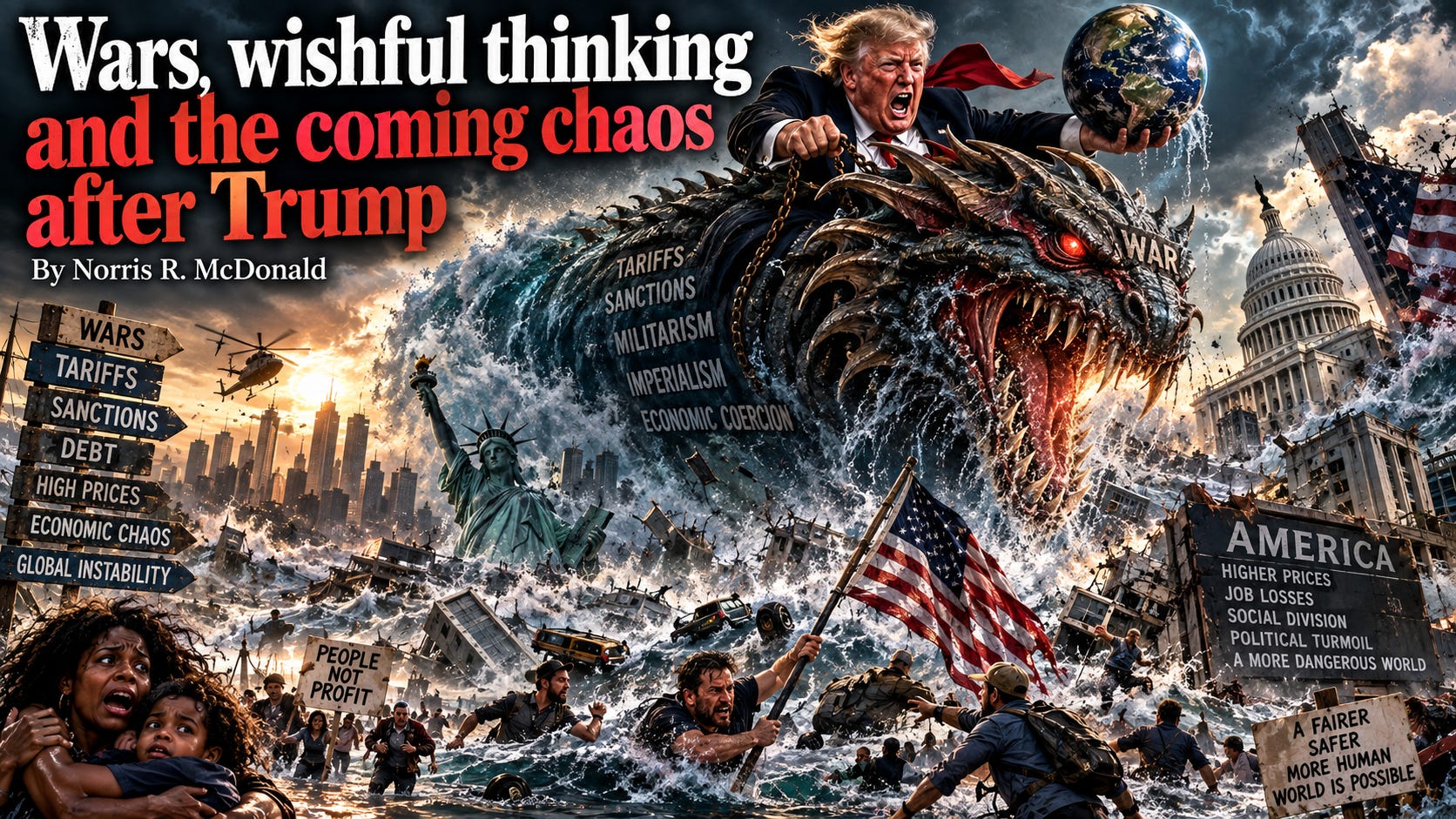
By Norris R. McDonald

Norris R. McDonald, Author & Human Rights Activist

When great powers play geopolitical chess, ordinary people become the pawns—and when the bombs stop falling, the bills do not.

That is the uncomfortable lesson of an increasingly dangerous world in which military power, economic coercion and geopo


litical rivalry collide with the everyday struggle for economic survival.

The United States and its allies still possess enormous military, financial and diplomatic power, but that power has limits. As American dominance faces growing challenges abroad and contradictions at home, Washington and its allies increasingly rely on tariffs, sanctions, military alliances and long-range weapons to preserve their influence.


Donald Trump has added a particularly volatile dimension through his nationalist agenda, aggressive tariff policies and willingness to confront allies and adversaries alike.

WARS AND THE POLITICS OF WISHFUL THINKING

Trump, however, did not create these contradictions. He accelerated them. The crisis is larger than one president or political party. It reflects a global system increasingly using military power and economic dominance to defend strategic interests while ordinary people absorb the costs.

The Russia-Ukraine war, now sustained by massive Western military support for Kyiv, illustrates these dangers. Western countries possess extraordinary military capabilities, but recent history demonstrates that military superiority does not automatically produce durable political outcomes.

Afghanistan, Iraq and Libya showed the enormous difference between destroying military targets and achieving lasting political objectives.

Russia presents an even more dangerous challenge. It is a nuclear-armed great power with substantial military capabilities, strategic depth and significant escalation options.

The question is not whether Western militaries are powerful—they unquestionably are—but whether military pressure can produce the desired political outcome without creating consequences more dangerous than the original objective.

ANDY BURNHAM AND EUROPEAN HUBRIS

That concern has become more pronounced with Britain’s expanding military support for Ukraine. Prime Minister Andy Burnham authorized actions concerning British components used in the SCALP/Storm Shadow missile system to facilitate greater Ukrainian capacity to produce long-range weapons.


Moscow responded with explicit threats to strike British military targets in response to Ukrainian attacks involving British-supplied long-range weapons. Whatever one’s view of Britain’s support for Ukraine, such exchanges can widen the circle of states Moscow regards as directly involved and increase the danger that a war already consuming Ukraine could spread beyond its borders.

This is the danger of geopolitical escalation. Each additional step is presented as necessary and controlled, yet their cumulative effect can erase the boundary between indirect involvement and direct confrontation. Eventually, governments may create consequences their architects can no longer control.

WHO ULTIMATELY PAYS?

Governments authorize billions of dollars in military spending while defence industries receive enormous contracts, and political leaders invoke national security. Ordinary people experience these conflicts through the price of food, transportation, electricity, rent and other necessities.

Wars disrupt energy markets, shipping routes, commodity supplies and international trade. Sanctions, tariffs and countersanctions can alter supply chains and increase import, transportation and production costs.

Wealthier countries have greater capacity to absorb these shocks. Smaller developing economies carrying significant debt and depending heavily on imports have far less room to manoeuvre.

That is why Jamaica cannot regard distant wars as somebody else’s problem. We import energy, food, manufactured goods, machinery and other essentials.

When shipping becomes more expensive, commodity prices rise or international uncertainty increases, the consequences eventually reach Jamaican households. The battlefield may be thousands of miles away, but the economic consequences are not.

THE POOR PAY THE BILL

The working class understands something political elites too often forget somebody eventually has to pay the bill.

Small farmers, artisans, daily-wage workers, pensioners, low-income families and the struggling middle class cannot command military alliances or negotiate trillion-dollar trade agreements. They absorb the consequences through reduced purchasing power and higher household costs.

Here lies a fundamental political contradiction. Governments can mobilize enormous resources when they declare a geopolitical emergency, yet ordinary citizens are repeatedly told that affordable housing, healthcare, education and stronger social protection must wait because there is insufficient money.

If governments can find billions for military priorities, why is comparable urgency so difficult to summon when people face housing, food and healthcare crises?

That is not merely an economic question. It is a question of political priorities.

BREAD-AND-BUTTER ISSUES AND THE CHAOS AFTER TRUMP

This is why bread-and-butter politics matters.

People want to know that they will be able to afford a decent home. They care about their children’s future and the need for good quality education. The rising cost of healthcare and prescription drugs are creating financial ruin. And this demand urgent solutions. Overall, wages must pace with living costs thereby allowing the working class to not only put food on the table but satisfy other basic needs.

In the end Donald Trump will eventually, unceremoniously, leave office. But the frustrations of the working class that he exploited with rampant racism and aggressive nationalism, will still confront America and demand urgent solutions.

The political turbulences created by Trump’s warmongering and virulent policies most certainly cannot be solved by a change of face to a Democratic or Republican politician who may be just as warmongering as he is.

Poor people and the middle class are exhausted. A stronger alternative begins with a different understanding of national power. A strong society is one in which people can afford to live with dignity, and a strong country is one in which families are not destroyed by food prices, housing costs, medical bills and insecure employment.

Maybe that’s why New York City Mayor Zohran Mamdani, Angie Nixon, Dr. Abdul Sayed, and other democratic socialists are scoring political successes. It is not about political rhetoric. It is about practical policies that eliminate hunger, homelessness, poor health, decrepit schools and inferior education.

Great power leaders can wave their oppressive flag of imperialism as high as they want. But they cannot hide the excruciating hunger of mothers and children belly pain.

In the end, people will judge their governments by the most basic measure of all: Can we afford to live and survive on scraps and handouts?

That is just the bitta truth.

About the Author

Norris R. McDonald is an author, respiratory therapist, and economic journalist whose work focuses on political economy, public health, healthcare systems, and global public policy. He is a regular contributor of public commentary and analysis for the Jamaica Gleaner, where he examines the intersection of economics, governance, social justice, and development in Jamaica, the Caribbean, and the Global South.

RESOURCES:

Caribbean Growth Illusion: Dead Money, Human Justice, and the Fight for Economic Dignity in 2026! WHY JAMAICA MUST PUT ITS WEALTH TO WORK!


Monday, March 23, 2026

AMERICA'S IRAN WAR --- IS NUCLEAR ESCALATION POSSIBLE?

... WHAT'S NEXT AFTER PRESIDENT TRUMP'S ANGRY THREAT!!!

Consumers are hurting as President Donald Trump continues his global war-mongering vanity projects, while bringing the world closer towards a potential nuclear disaster. 

By Norris R. McDonald

(Updated April 7, 2026)

SULFABITTAS: Caribbean Political Analysis


The emerging confrontation between the United States and Iran underscores a recurring flaw in modern military strategy: the belief that large-scale force can be applied in a controlled, limited, and predictable manner. Recent developments suggest that this assumption is not only fragile, but potentially dangerous.

Norris R. McDonald

While Washington may seek to define the scope and duration of conflict, history demonstrates that wars involving capable regional powers rarely unfold according to plan. Instead, they evolve through cycles of action and reaction, shaped as much by miscalculation and political pressure as by initial intent.

The central question is no longer whether conflict can begin under controlled conditions—but whether it can remain contained once escalation dynamics take hold. On this issue, the outlook remains deeply uncertain.


STRATEGIC DRIFT AND OPERATIONAL REALITIES

Reports of battlefield setbacks and rising tensions point to deeper structural issues: unclear objectives, over-reliance on military force, and insufficient diplomatic engagement. Tactical successes—if achieved—have not translated into strategic clarity.

This reflects a broader pattern seen in conflicts such as the Iraq War, where initial dominance gave way to prolonged instability.

The assumption that escalation can be finely calibrated ignores a key reality: once force is employed, control shifts from planners to events.


IRAN’S ASYMMETRIC ADVANTAGE

Iran’s military doctrine is designed around asymmetry. Unable to match U.S. conventional power, it compensates through:

  • Missile capabilities targeting regional assets
  • Naval disruption, particularly in the Strait of Hormuz
  • A network of aligned non-state actors

Groups such as Hezbollah and regional militias expand the battlefield beyond Iran’s borders, transforming any bilateral conflict into a multi-front regional struggle.

This diffusion of conflict space significantly reduces the likelihood of a quick or decisive outcome.


THE LOGIC OF ESCALATION

Escalation in modern warfare is cumulative and self-reinforcing. Each action invites retaliation, and each retaliation broadens the scope of conflict.

In a U.S.–Iran scenario, this could include:

  • Missile exchanges across the region
  • Cyberattacks on critical infrastructure
  • Maritime disruption affecting global energy flows

Over time, such dynamics produce not decisive victories, but sustained confrontation—marked by attrition, rising costs, and strategic ambiguity.


THE NUCLEAR DIMENSION

The most consequential risk lies not in immediate nuclear war, but in how prolonged conflict reshapes nuclear incentives.

Iran, while not currently a declared nuclear weapons state, could reassess its position if faced with existential threat. Historical precedent—such as North Korea—demonstrates how security pressure can accelerate nuclear decision-making.

At the same time, regional actors like Saudi Arabia may reconsider their own strategic posture, raising the risk of a broader proliferation cascade.

Meanwhile, established nuclear powers such as Israel remain critical variables in any escalation scenario.


IS NUCLEAR ESCALATION POSSIBLE?

Yes—but not in the immediate or simplistic sense.

The greater danger is gradual:

  • A prolonged war increases desperation
  • Desperation alters strategic calculations
  • Altered calculations increase nuclear risk

In this sense, nuclear escalation is less a sudden event than a process driven by sustained conflict pressure.


The notion that the United States could initiate military action against Iran while retaining control over its scope and duration reflects a persistent illusion in contemporary statecraft, namely that force can be calibrated with precision even in highly volatile environments. 


In reality, conflicts involving capable regional powers rarely conform to initial expectations, as they are shaped not only by planning but by reaction, miscalculation, and the independent decisions of multiple actors operating under pressure.


The central analytical problem is therefore not whether a conflict could begin under controlled conditions, but whether it could be contained once reciprocal escalation takes hold. On this question, the outlook is deeply uncertain, because the mechanisms that drive conflict expansion are structural rather than incidental, and once activated, they tend to override attempts at restraint.


IRAN’S MILITARY POSTURE AND REGIONAL ENTANGLEMENT

Iran’s defense posture is built around the recognition that it cannot match the United States symmetrically, and therefore must compete asymmetrically, leveraging geography, missile capability, and regional relationships to offset conventional disadvantages. Its terrain complicates large-scale maneuver operations, while its distributed military infrastructure reduces vulnerability to decisive strikes.


More importantly, Iran’s integration into a network of aligned actors across the Middle East ensures that any direct confrontation would extend beyond its borders, transforming a bilateral conflict into a broader regional contest. This diffusion of the battlefield increases both operational complexity and escalation risk, while simultaneously reducing the likelihood of a clear or contained outcome.


Under such conditions, a ground invasion would not represent a discrete campaign with identifiable endpoints, but rather a long-duration commitment requiring sustained force projection, resilient logistics, and continued domestic political support, all of which are difficult to maintain over extended periods.


ESCALATION AND THE LOGIC OF PROLONGED CONFLICT

Escalation in modern warfare follows a logic that is both cumulative and difficult to reverse, as each action generates incentives for response, and each response expands the range of potential outcomes. In the context of a U.S.–Iran conflict, initial military engagement would likely trigger a sequence of retaliatory measures spanning multiple domains, including missile exchanges, cyber operations, and disruptions to maritime activity.


Over time, this pattern would produce a conflict environment defined less by decisive engagements than by sustained pressure, in which both sides seek to impose cost without achieving resolution. Such conditions favor duration over decisiveness, increasing the probability that the conflict evolves into a prolonged struggle characterized by resource expenditure, strategic fatigue, and diminishing clarity of purpose.


THE NUCLEAR DIMENSION AND ESCALATION UNDER PRESSURE

The most consequential, and often under-examined, dimension of such a conflict lies in its potential to alter nuclear calculations across the region. While Iran’s current posture remains below the threshold of deployed nuclear capability, a full-scale confrontation could fundamentally reshape its incentives, particularly if leadership perceives an existential threat.


Are we at the brink of a nuclear catastrophe?

In such a scenario, the acceleration of nuclear development becomes not merely a strategic option, but a survival mechanism, while regional actors respond by adjusting their own deterrence postures in ways that heighten tension and compress decision timelines. The resulting environment is one in which the margin for error narrows significantly, increasing the risk that misinterpretation or rapid escalation could produce outcomes that were neither intended nor anticipated at the outset.


The danger, therefore, is not limited to deliberate escalation, but includes the systemic risk generated by a conflict operating under extreme pressure with multiple actors and limited time for deliberation.


ECONOMIC INTERDEPENDENCE AND THE COST OF DISRUPTION

The economic consequences of a conflict with Iran would be immediate and far-reaching, reflecting the centrality of the Middle East to global energy markets and the sensitivity of those markets to disruption. Even limited instability has historically produced measurable price volatility, and a sustained conflict would likely amplify these effects, transmitting shock through global supply chains.


The American economy is blowing like a geyser with war driven inflation and, it will likely get worse, and more dangerous; as an untrammeled President Donald Trump expands this illegal Iran war. 
The practical implications include rising energy costs, increased transportation expenses, and broader inflationary pressures that affect both advanced and developing economies. For the United States, this translates into higher costs for consumers and businesses alike, reinforcing the connection between external conflict and domestic economic stability.


In this sense, the economic dimension is not secondary to the military one, but operates in parallel, shaping both the duration and the perceived cost of engagement.


LIMITS OF FORCE AND THE QUESTION OF PURPOSE

At the core of the issue lies a fundamental question about the relationship between military action and political objectives. Force can degrade capabilities and impose cost, but it does not inherently produce stable or lasting outcomes, particularly in environments characterized by resilience and decentralization.


A ground war with Iran would test these limits directly, requiring not only initial success but sustained control over a complex and resistant environment, a task that extends beyond conventional definitions of victory. Without a clearly defined and achievable objective, the use of force risks becoming an open-ended commitment, where the costs continue to accumulate in the absence of resolution.


BOTTOMLINE: THE COST OF MISJUDGMENT

A U.S. ground war with Iran would represent a high-risk undertaking with uncertain outcomes and potentially irreversible consequences, spanning military, economic, and geopolitical domains. The most plausible trajectory is not one of rapid success, but of prolonged engagement marked by escalation, resource strain, and increasing systemic risk, including the possibility of nuclear proliferation under pressure.


The critical challenge is therefore not one of capability, but of judgment—recognizing that the decision to initiate conflict must be grounded not only in the ability to begin, but in the capacity to conclude. Where that capacity is absent, the use of force ceases to serve as an instrument of policy and instead becomes a source of instability.

Avoiding such an outcome requires clarity, restraint, and a willingness to confront the limits of power before those limits are tested in ways that cannot be easily reversed.


The current trajectory suggests a conflict that risks becoming:

  • Prolonged rather than decisive
  • Regional rather than contained
  • Structurally escalatory rather than controllable

Absent clear objectives and renewed diplomatic pathways, the United States risks entering a strategic environment where military action generates consequences faster than policy can adapt.


The lesson is not merely about Iran—but about the enduring limits of force in an interconnected and volatile geopolitical landscape.


The U.S. war with Iran reveals stark strategic failures rooted in unclear objectives, over‑reliance on force, diplomatic breakdowns, and misreading Tehran’s motivations. From disruption in the Strait of Hormuz to domestic splits in political leadership, America’s current approach has generated tactical successes but no sustainable resolution — risking a prolonged conflict with deep global repercussions. Recognizing and correcting these blunders is essential for future U.S. foreign policy and long‑term security in the Middle East.


ABOUT THE AUTHOR: 

Norris R. McDonald is the News Editor of SULFABITTAS NEWS and a public health policy analyst and commentator on human rights, global affairs, environmental justice, and sustainable development. His writing focuses on the intersection of international policy, health systems, and global development.

***********************************

 FREQUENTLY ASKED QUESTIONS (FAQ)


Could a war with Iran realistically escalate to nuclear conflict?

Yes, particularly under conditions of sustained pressure and perceived existential threat, which could accelerate nuclear development and increase the risk of confrontation involving multiple regional actors.


Why is a ground invasion especially risky?

Because it would require long-term military presence, extensive logistical support, and sustained political backing in a complex and resistant environment without a guaranteed endpoint.


What makes this conflict different from past wars?

Its regional interconnectedness, escalation dynamics, and nuclear implications create a level of complexity and risk that extends beyond conventional military engagement.


How would this affect the U.S. economy?

Energy market disruption would likely drive inflation, increase costs for consumers, and create broader economic instability with lasting effects.


What is the central takeaway?

The greatest danger lies not in the initial decision to use force, but in entering a conflict that cannot be clearly defined, controlled, or concluded.


FOLLOW SULFABITTAS NEWS FOR MORE IN-DEPTH REPORTING ON ISSUES THAT IMPACT YOUR LIVES!  

CONTINUE THE CONVERSATION AND TELL US WHAT YOU THINK👇


The Revolt Against Empire: America, Israel, Iran and the End of the 'One Don' World Order!' 


________________________


"AMERICA MUST NOT FOLLOW ISRAEL LIKE A STUPID MULE INTO A WAR WITH IRAN!"

War, Energy, and the High Cost of Strategic Overreach!  — Brzezinski’s Warning Ignored