
A radical analysis of U.S. decline, Iran’s resistance, Israel’s wars, and the rise of a multipolar world order!

Editor’s Note (April 2026):
This article is an updated and expanded version of my earlier analysis, incorporating recent geopolitical developments, including the escalating confrontation involving the United States, Israel, and Iran, and the accelerating shift toward a multipolar global order. 👉 Read the original version here: [ https://sulfabittasnews.blogspot.com/2026/03/israel-america-iran-religion-great.html]
By Norris R. McDonald, DIJ
SULFABITTAS NEWS | April 2026
Empire in Crisis: Not Defeat, but Delegitimation
 |
| Norris R. McDonald, DIJ, Author. |
For much of the post-Cold War period, the United States maintained global primacy not only through military superiority and financial dominance, but through a narrative architecture that presented its power as stabilizing, normative, and historically inevitable. That narrative has steadily eroded. What we are witnessing is not the sudden demise of empire, but its gradual delegitimation across multiple regions and political constituencies.
This erosion has been accelerated by prolonged military engagements, humanitarian crises associated with allied operations, and the widening gap between professed democratic ideals and observed geopolitical practice. As a result, opposition to U.S.-aligned power structures is no longer confined to adversarial states; it is increasingly embedded within global public opinion, particularly across the Global South.
Iran and the Political Sociology of Resistance
The case of Iran illustrates a broader sociopolitical phenomenon: external pressure, when applied to ideologically cohesive societies, often reinforces rather than weakens internal legitimacy. The historical legacy of Ruhollah Khomeini exemplifies how confrontation with external powers can transform national leadership into enduring symbols of resistance.
 |
| Dr. Brzezinski warned that America shouldn't let Israel lead it like "a stupid mule" into a war with Iran. |
Over decades, sanctions, diplomatic isolation, and covert confrontation have not produced regime collapse. Instead, they have contributed to the consolidation of a political identity rooted in sovereignty, religious legitimacy, and anti-imperialist discourse. Iran’s regional posture—expressed through alliances, proxy networks, and strategic deterrence—cannot be fully understood through conventional balance-of-power analysis alone; it must also be situated within a narrative of civilizational resistance that resonates beyond its borders.
In this sense, Iran functions not merely as a state actor, but as a node within a broader ideological ecosystem that challenges Western hegemony.
Israel, Asymmetry, and the Crisis of Moral Authority
 |
| Over 28,000 Palestinian women and girls have been reportedly killed during the International Court of Justice declared Israel's genocide in Gaza. |
Israel’s position within this geopolitical configuration is both central and increasingly contested. While its military capabilities remain formidable, the political consequences of prolonged asymmetric conflict—particularly in Gaza—have contributed to a widening legitimacy gap in global perception.
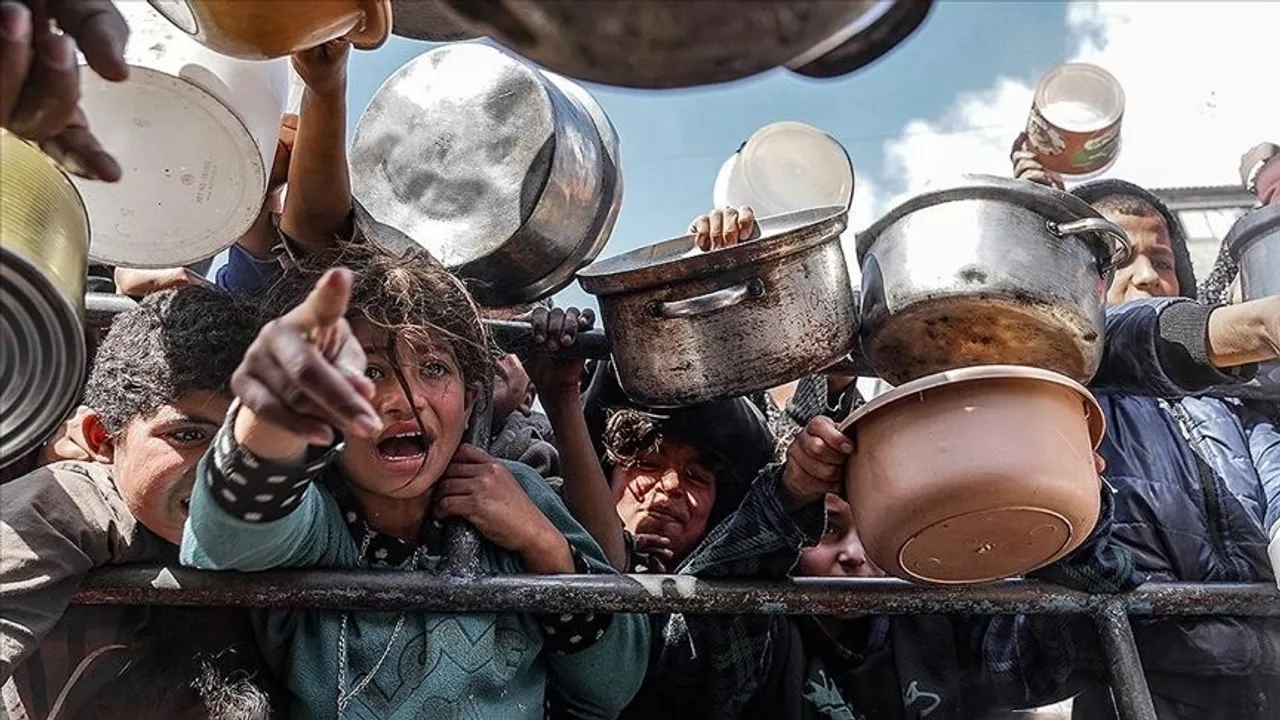 |
| Israel has been accused by the International Court of Justice of using "starvation as a weapon of war," which is a war crime. |
This shift is especially pronounced outside Western political spheres, where the framing of Israeli security policy is increasingly interpreted through the lenses of occupation, dispossession, and structural inequality. The result is not simply diplomatic friction, but a deeper reconfiguration of how power, justice, and resistance are understood in the international system.
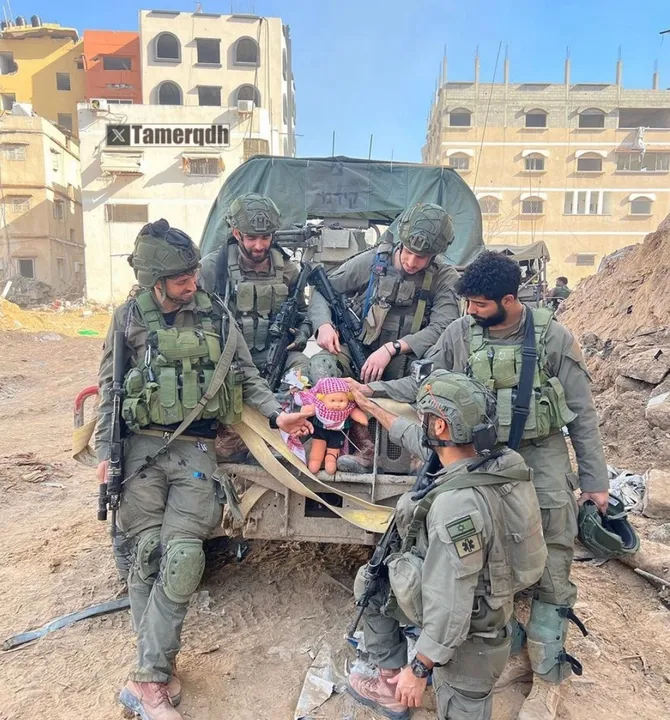
 |
| Israel soldiers taunts a young child, in a clear show of their moral illegitimacy. |
Crucially, the sustainability of any hegemonic order depends not only on coercive capacity but on moral authority. Where that authority is persistently challenged, even overwhelming force struggles to produce durable political outcomes.
From Fukuyama to Huntington: The Return of History
The intellectual optimism that followed the Cold War, most notably articulated by Francis Fukuyama in The End of History and the Last Man, rested on the assumption that ideological convergence toward liberal democracy was both inevitable and universal. That assumption now appears historically contingent rather than structurally grounded.
In contrast, Samuel P. Huntington’s framework in The Clash of Civilizations and the Remaking of World Order anticipated a world in which cultural and civilizational identities would persist as primary drivers of conflict. While Huntington’s thesis has often been criticized for its determinism, its core insight—that identity remains politically salient—has been repeatedly validated in contemporary geopolitics.
The persistence of religious, cultural, and historical narratives in shaping state behavior suggests that globalization has not dissolved difference; it has, in many cases, intensified it.
Global South Agency and the Rejection of Subordination
Across the Global South, a discernible pattern is emerging: states and societies are increasingly asserting agency within a system that historically constrained their sovereignty. This is evident in West Africa’s reassessment of foreign military presence, Latin America’s renewed emphasis on economic independence, and Asia’s evolving trade architectures.
These developments should not be interpreted as isolated geopolitical shifts, but as components of a broader structural realignment in which post-colonial societies are renegotiating their position within the global order. The language of resistance, long associated with revolutionary movements, is now embedded in state policy, regional cooperation, and economic strategy.
Such transformations underscore a fundamental principle: systems of domination generate counter-systems of resistance, and over time, those counter-systems acquire institutional form.
American Nationalism and the Unmasking of Power
The political trajectory represented by Donald Trump reflects an internal dimension of this global transition. Rather than initiating a break from established patterns, Trump-era nationalism exposed underlying dynamics that had long characterized U.S. foreign policy—namely, the prioritization of strategic dominance over multilateral consensus.
 |
| President Donald Trump exemplifies the rabid rise of American Nationalism with imbued with a clear, narcissistic 'God King Complex!' |
This shift has had paradoxical effects. Domestically, it has intensified polarization; internationally, it has reduced the ideological coherence of American leadership. The result is a form of power that remains materially significant but increasingly contested in normative terms.
Multipolarity as Structure, Not Slogan
The emergence of multipolarity is often described rhetorically, but its foundations are concrete. The rise of Xi Jinping, the expansion of BRICS, and the persistence of alternative financial and political networks indicate a redistribution of global influence.
However, multipolarity does not signify equilibrium. It represents a transitional condition characterized by competition, overlapping spheres of influence, and institutional fragmentation. In such an environment, power is negotiated rather than assumed, and legitimacy becomes a central currency of international relations.
The End of the “One Don” Paradigm
The notion of a singular, uncontested global authority—the so-called “One Don World Order”—was always historically anomalous. Its apparent stability in the 1990s and early 2000s reflected a unique convergence of economic, military, and ideological factors that are no longer present.
What is unfolding today is not the abrupt dismantling
of American power, but its transformation within a more complex and contested system. The United States remains a central actor, yet it operates within constraints that limit its ability to unilaterally define outcomes.
This distinction is critical. Hegemony has not disappeared, but it has been relativized.
Conclusion: Resistance as a Structural Force
The defining feature of the current global moment is not the rise of any single power, but the normalization of resistance as a structural force in international politics. From Iran’s defiance to Global South realignments, from shifting public opinion to emerging economic blocs, the architecture of dominance is being continuously challenged.
History, far from ending, has entered a phase in which multiple trajectories coexist—conflict and cooperation, dominance and resistance, fragmentation and integration.
The future of the international system will not be determined solely by military capacity or economic scale, but by the ability of states and societies to generate legitimacy, mobilize identity, and sustain political will.
In that context, the era of the “One Don” is not simply ending.
It is being replaced by a world in which no single power can rule without contest—and no system of domination can endure without resistance.
[This analysis builds on earlier work examining the myth of the “One Don World Order.” Comparing both versions reveals how rapidly global power dynamics are shifting.👉 https://sulfabittasnews.blogspot.com/2026/03/israel-america-iran-religion-great.html ]
Copyright 2026- Norris R. McDonald, SULFABITTAS NEWS, @sulfabittas
About the Author
Norris R. McDonald is an author, respiratory therapist, and economic journalist whose work focuses on political economy, public health, healthcare systems, and global public policy. He is a regular contributor of public commentary and analysis for the Jamaica Gleaner, where he examines the intersection of economics, governance, social justice, and development in Jamaica, the Caribbean, and the Global South.
With professional training in Economic Journalism and respiratory care and, decades of frontline healthcare experience, McDonald brings a clinical and evidence-based perspective to issues from global conflicts and foreign policy; to maternal mortality, health inequities, pharmaceutical policy, and healthcare access. His journalism blends data-driven analysis with historical and cultural context, particularly around Black communities, post-colonial development, and structural inequality.
McDonald is also the publisher of Sulfabittas Newsmagazine on Substack, where he produces investigative features, long-form essays, and geopolitical commentary on global power dynamics, economic sovereignty, and emerging multipolar realities.
________
Follow Sulfabittas News for comprehensive political analysis on major Caribbean and global political developments affecting Jamaica and the world.

- A biting allegorical fable exposing the corruption of money, tech power, and politics.
- “Musk Rat” and “Ronald the Snake” stand in for real-world archetypes of greed, betrayal, and dystopia.
- Echoes the tradition of George Orwell, Franz Kafka, and Animal Farm — but with a Caribbean/Jamaican sharp-edge “Bitta Truth” style.
- Satire that blends animal fable + dystopian critique — accessible yet piercing.
- A Satirical Allegory of Power, Greed, and Collapse
- A Political Fable of America’s Descent into Chaos
- A Dark Allegory of Money, Corruption, and Betrayal
- Read the Story the World Needs
- Experience the Journey
- Start Reading Now
- Own This Powerful book!
GET YOUR COPY HERE: 👉 https://www.amazon.com/True-Life-Story-Ronald-Snake/dp/B0DXL8RGNZ/

No comments:
Post a Comment