Sunday, September 6, 2026

Wars, wishful thinking and the coming chaos after Trump!


The MAGA Shockwave: How Donald Trump’s nationalist agenda is rewriting the global order and setting up a volatile future!
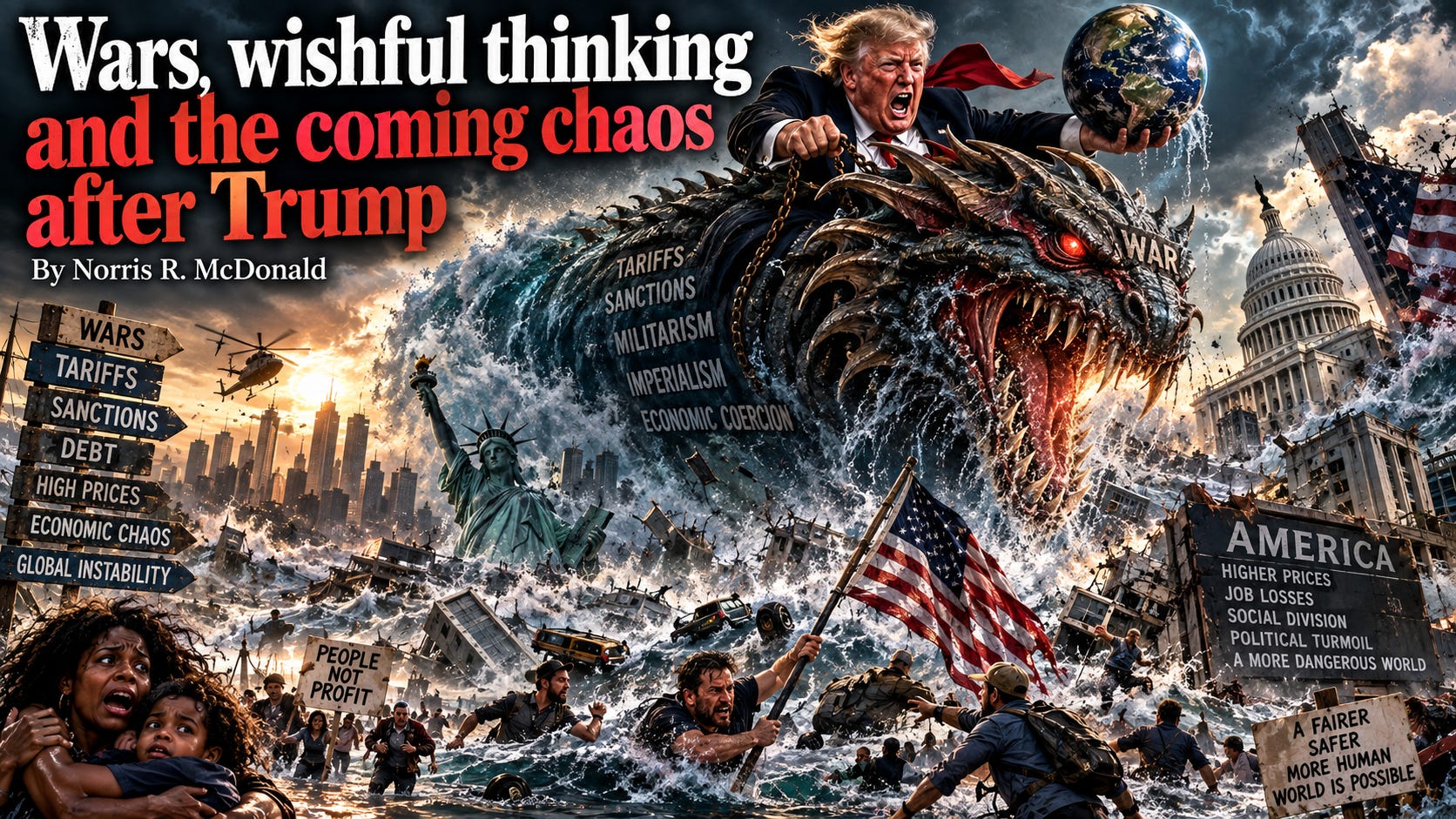
By Norris R. McDonald

Norris R. McDonald, Author & Human Rights Activist

When great powers play geopolitical chess, ordinary people become the pawns—and when the bombs stop falling, the bills do not.

That is the uncomfortable lesson of an increasingly dangerous world in which military power, economic coercion and geopo


litical rivalry collide with the everyday struggle for economic survival.

The United States and its allies still possess enormous military, financial and diplomatic power, but that power has limits. As American dominance faces growing challenges abroad and contradictions at home, Washington and its allies increasingly rely on tariffs, sanctions, military alliances and long-range weapons to preserve their influence.


Donald Trump has added a particularly volatile dimension through his nationalist agenda, aggressive tariff policies and willingness to confront allies and adversaries alike.

WARS AND THE POLITICS OF WISHFUL THINKING

Trump, however, did not create these contradictions. He accelerated them. The crisis is larger than one president or political party. It reflects a global system increasingly using military power and economic dominance to defend strategic interests while ordinary people absorb the costs.

The Russia-Ukraine war, now sustained by massive Western military support for Kyiv, illustrates these dangers. Western countries possess extraordinary military capabilities, but recent history demonstrates that military superiority does not automatically produce durable political outcomes.

Afghanistan, Iraq and Libya showed the enormous difference between destroying military targets and achieving lasting political objectives.

Russia presents an even more dangerous challenge. It is a nuclear-armed great power with substantial military capabilities, strategic depth and significant escalation options.

The question is not whether Western militaries are powerful—they unquestionably are—but whether military pressure can produce the desired political outcome without creating consequences more dangerous than the original objective.

ANDY BURNHAM AND EUROPEAN HUBRIS

That concern has become more pronounced with Britain’s expanding military support for Ukraine. Prime Minister Andy Burnham authorized actions concerning British components used in the SCALP/Storm Shadow missile system to facilitate greater Ukrainian capacity to produce long-range weapons.


Moscow responded with explicit threats to strike British military targets in response to Ukrainian attacks involving British-supplied long-range weapons. Whatever one’s view of Britain’s support for Ukraine, such exchanges can widen the circle of states Moscow regards as directly involved and increase the danger that a war already consuming Ukraine could spread beyond its borders.

This is the danger of geopolitical escalation. Each additional step is presented as necessary and controlled, yet their cumulative effect can erase the boundary between indirect involvement and direct confrontation. Eventually, governments may create consequences their architects can no longer control.

WHO ULTIMATELY PAYS?

Governments authorize billions of dollars in military spending while defence industries receive enormous contracts, and political leaders invoke national security. Ordinary people experience these conflicts through the price of food, transportation, electricity, rent and other necessities.

Wars disrupt energy markets, shipping routes, commodity supplies and international trade. Sanctions, tariffs and countersanctions can alter supply chains and increase import, transportation and production costs.

Wealthier countries have greater capacity to absorb these shocks. Smaller developing economies carrying significant debt and depending heavily on imports have far less room to manoeuvre.

That is why Jamaica cannot regard distant wars as somebody else’s problem. We import energy, food, manufactured goods, machinery and other essentials.

When shipping becomes more expensive, commodity prices rise or international uncertainty increases, the consequences eventually reach Jamaican households. The battlefield may be thousands of miles away, but the economic consequences are not.

THE POOR PAY THE BILL

The working class understands something political elites too often forget somebody eventually has to pay the bill.

Small farmers, artisans, daily-wage workers, pensioners, low-income families and the struggling middle class cannot command military alliances or negotiate trillion-dollar trade agreements. They absorb the consequences through reduced purchasing power and higher household costs.

Here lies a fundamental political contradiction. Governments can mobilize enormous resources when they declare a geopolitical emergency, yet ordinary citizens are repeatedly told that affordable housing, healthcare, education and stronger social protection must wait because there is insufficient money.

If governments can find billions for military priorities, why is comparable urgency so difficult to summon when people face housing, food and healthcare crises?

That is not merely an economic question. It is a question of political priorities.

BREAD-AND-BUTTER ISSUES AND THE CHAOS AFTER TRUMP

This is why bread-and-butter politics matters.

People want to know that they will be able to afford a decent home. They care about their children’s future and the need for good quality education. The rising cost of healthcare and prescription drugs are creating financial ruin. And this demand urgent solutions. Overall, wages must pace with living costs thereby allowing the working class to not only put food on the table but satisfy other basic needs.

In the end Donald Trump will eventually, unceremoniously, leave office. But the frustrations of the working class that he exploited with rampant racism and aggressive nationalism, will still confront America and demand urgent solutions.

The political turbulences created by Trump’s warmongering and virulent policies most certainly cannot be solved by a change of face to a Democratic or Republican politician who may be just as warmongering as he is.

Poor people and the middle class are exhausted. A stronger alternative begins with a different understanding of national power. A strong society is one in which people can afford to live with dignity, and a strong country is one in which families are not destroyed by food prices, housing costs, medical bills and insecure employment.

Maybe that’s why New York City Mayor Zohran Mamdani, Angie Nixon, Dr. Abdul Sayed, and other democratic socialists are scoring political successes. It is not about political rhetoric. It is about practical policies that eliminate hunger, homelessness, poor health, decrepit schools and inferior education.

Great power leaders can wave their oppressive flag of imperialism as high as they want. But they cannot hide the excruciating hunger of mothers and children belly pain.

In the end, people will judge their governments by the most basic measure of all: Can we afford to live and survive on scraps and handouts?

That is just the bitta truth.

About the Author

Norris R. McDonald is an author, respiratory therapist, and economic journalist whose work focuses on political economy, public health, healthcare systems, and global public policy. He is a regular contributor of public commentary and analysis for the Jamaica Gleaner, where he examines the intersection of economics, governance, social justice, and development in Jamaica, the Caribbean, and the Global South.

RESOURCES:

Caribbean Growth Illusion: Dead Money, Human Justice, and the Fight for Economic Dignity in 2026! WHY JAMAICA MUST PUT ITS WEALTH TO WORK!


Monday, July 13, 2026

HUMAN JUSTICE ECONOMICS: 'Dead Money' and Jamaica's Forgotten Development Strategy

THE DEAD MONEY SERIES -Part 11... 

Macroeconomic stability was never supposed to be the final destination. It was intended to become the foundation upon which productive wealth, national ownership and economic sovereignty could be built.


By Norris R. McDonald, SULFABITTAS NEWS, Caribbean Political Analysis, July 13, 2026 (Updated July 14)

Reviving Jamaica's Forgotten Development Vision

Norris R.McDonald
Part I argued that Jamaica's remarkable success in restoring macroeconomic stability has not produced a corresponding expansion in productive wealth. Debt ratios have improved, inflation has moderated and foreign exchange reserves have reached historically comfortable levels, yet many Jamaicans continue struggling with stagnant wages, rising living costs, declining agricultural production and limited opportunities to accumulate wealth. 

The contradiction is becoming increasingly difficult to ignore. Fiscal discipline has restored financial credibility, but financial credibility alone cannot generate the jobs, industries, technological innovation and productive enterprises necessary to raise living standards. Stability protects an economy from collapse, but stability by itself does not build prosperity. The next phase of Jamaica's development therefore requires a deliberate transition from preserving financial assets to mobilising them for productive national investment.

Growing more, feeding Jamaica's future.

This challenge is neither new nor theoretical. More than four decades ago, Jamaica's policymakers, economists and development planners wrestled with precisely the same question. Could a small developing country escape the historical legacy of plantation dependency by strengthening domestic production, expanding industrial capacity, increasing agricultural output and mobilising local savings to finance its own development? The search for those answers produced one of the most ambitious economic exercises in modern Jamaican history—the National Production Plan.

The National Production Plan

My interest in this debate is not simply academic. As the representative of the Minister of National Mobilization, Dr. D.K. Duncan, I served on the Economic Commission responsible for preparing the National Production Plan. It was a remarkable period of intellectual engagement. Working alongside distinguished economists, including Professors George Beckford, Michael Witter, and other accomplished Jamaican scholars and public servants, we attempted to develop an economic framework capable of reducing Jamaica's dependence upon imported goods, external borrowing and foreign ownership while strengthening domestic production, manufacturing, agriculture and national capital formation. The objective was never isolation from the global economy. Rather, it was to ensure that Jamaica participated in the international economy from a position of greater productive strength and economic self-confidence.

Unfortunately, history intervened. As international economic conditions deteriorated and Jamaica confronted mounting fiscal and balance-of-payments pressures, policy priorities shifted toward stabilisation, structural adjustment and debt management under programmes supported by the International Monetary Fund. Those reforms undoubtedly restored important elements of financial credibility and helped prevent even deeper economic instability. Yet they also redirected national attention away from the longer-term challenge of expanding productive capacity. Fiscal adjustment gradually became the centrepiece of economic policy while the broader vision of production-led development receded into the background.

The consequences remain visible today. Jamaica has become considerably more successful at managing public finances than at expanding domestic production. Agricultural imports continue to absorb valuable foreign exchange. Manufacturing contributes a relatively modest share of national output. Too many talented young professionals continue to migrate overseas. Rural communities struggle with inadequate irrigation, poor feeder roads and limited access to productive credit, while many entrepreneurs remain constrained by high financing costs and insufficient investment capital. These structural weaknesses cannot be solved through balanced budgets alone. They require deliberate, sustained investment in the productive sectors that generate long-term national wealth.

Beckford, Witter and the Meaning of Productive Wealth

The intellectual foundation for that alternative development strategy was articulated most powerfully by Professors George Beckford and Michael Witter in Small Garden, Bitter Weed. Their work challenged Jamaicans to think beyond short-term macroeconomic management and confront the deeper structural realities inherited from the plantation economy. Beckford argued that although political independence had been achieved, the economic structures of colonialism continued to shape production, ownership and the distribution of wealth. The plantation economy had not simply disappeared with the lowering of the Union Jack. It had evolved. Too often, wealth continued to flow outward while domestic production remained constrained, leaving Jamaica dependent upon imports, foreign capital and external markets.

That analysis remains remarkably relevant in 2026. Jamaica has become more financially stable, yet the productive sectors capable of generating broad-based prosperity continue to lag behind. Tourism remains the dominant foreign exchange earner, but much of its value chain leaks overseas through imported food, foreign ownership and profit repatriation. Agriculture possesses enormous untapped potential, yet the country continues importing billions of dollars' worth of food each year. Manufacturing has survived but has not expanded sufficiently to become a major engine of economic transformation. The result is an economy that has become increasingly proficient at managing scarcity while still struggling to generate abundance.

The consequences are visible in the daily lives of ordinary Jamaicans. Many workers remain trapped in low-paying employment with little opportunity to accumulate assets or pass wealth to the next generation. Young graduates often conclude that migration offers the most reliable path to economic advancement. Farmers battle uncertain markets, inadequate irrigation and poor rural infrastructure, while entrepreneurs frequently confront high borrowing costs and limited access to long-term investment capital. These are not merely individual hardships; they are symptoms of an economy that has not yet fully converted financial stability into productive expansion.

From Dead Money to Living Capital

This is where the concept of Dead Money becomes important. Jamaica's foreign exchange reserves are not inherently problematic. They perform a vital role in protecting the economy from external shocks and maintaining confidence in the Jamaican dollar. No serious economist would advocate recklessly exhausting those reserves. The issue is whether financial strength should remain largely passive while productive opportunities continue to be underfunded.

Human Justice Economics suggests a different approach. It asks whether accumulated national wealth can become a catalyst for expanding productive capacity through carefully governed institutions that preserve macroeconomic stability while mobilizing investment for long-term development. The objective is not indiscriminate government spending. It is disciplined investment in those sectors capable of generating sustainable returns for society as a whole—modern irrigation systems that increase agricultural output, renewable energy projects that reduce imported fuel costs, digital infrastructure that strengthens competitiveness, affordable housing that builds family wealth, scientific research that stimulates innovation and manufacturing that adds value to Jamaican resources.

Building dreams!

Every successful economy eventually reaches a point where protecting wealth is no longer sufficient. Prosperity depends upon putting wealth to work. Money sitting passively in financial accounts may preserve stability, but money invested prudently in productive enterprises creates employment, expands output, broadens the tax base and generates still more wealth. That is the difference between preserving capital and multiplying it.

A National Development Conversation

This is why Jamaica needs a mature national conversation about development. The debate should not be framed as a choice between fiscal discipline and productive investment, because the two are complementary rather than contradictory. Fiscal responsibility provides the confidence necessary for investment, while productive investment strengthens the economy that ultimately sustains fiscal responsibility. One without the other produces an incomplete development strategy.

The discussion should therefore extend well beyond political parties. Economists, manufacturers, farmers, financial institutions, universities, trade unions, entrepreneurs and community organizations all have a stake in determining how Jamaica's accumulated financial strength can support a new generation of productive investment. The question is not whether the country should abandon prudent macroeconomic management. The question is how that hard-earned stability can become the launching pad for stronger domestic production, higher productivity, technological advancement and broader national ownership.

Building Jamaica's future through investment!

History suggests that Jamaica has confronted this challenge before. Michael Manley's Capital Development Fund, the National Housing Trust and the National Production Plan all reflected an understanding that national savings and national resources should be mobilised to build productive assets capable of serving future generations. Those institutions emerged from a philosophy that recognised development as more than balancing budgets. Development meant creating wealth, expanding opportunity and strengthening the productive foundations of the nation.

Part III of this series will examine how Jamaica could adapt those historical lessons to the twenty-first century through a modern National Development Fund protected by legislation, insulated from partisan politics and governed by the highest standards of transparency, accountability and professional investment management. The objective would not be to replace fiscal discipline but to ensure that financial strength becomes the engine of productive prosperity rather than remaining dormant as Dead Money.

That is the Just Bitta Truth.

ABOUT THE AUTHOR

About the Author

Norris R. McDonald is an author, respiratory therapist, and economic journalist whose work focuses on political economy, public health, healthcare systems, and global public policy. He is a regular contributor of public commentary and analysis for the Jamaica Gleaner, where he examines the intersection of economics, governance, social justice, and development in Jamaica, the Caribbean, and the Global South.

RESOURCES:

Caribbean Growth Illusion: Dead Money, Human Justice, and the Fight for Economic Dignity in 2026! WHY JAMAICA MUST PUT ITS WEALTH TO WORK!

THE MINISTRY OF NATIONAL MOBILIZATION AND HUMAN RESOURCE DEVELOPMENT, MINISTRY PAPER NO. 26, ON PARISH PRODUCTION COMMISSIONS


Friday, July 3, 2026

HUMAN JUSTICE ECONOMICS: Dead Money, Human Justice, and the Fight for Economic Dignity in 2026!-Part 1

WHY JAMAICA MUST PUT ITS WEALTH TO WORK! 


By Norris R. McDonald, DIJ, Author

Caribbean Political Analysis,

SULFABITTAS NEWS, July 3, 2026 (Updated July 13, 2026).

Norris R. McDonald, DIJ, Author, Human Rights Advocate.

At first light in rural St. Mary, Jamaica, a mother prepares breakfast over a coal stove because cooking gas has slipped beyond her reach.


What began as a temporary adjustment has hardened into a permanent condition shaped by rising prices, stagnant wages, and quiet resignation. 

Her grocery bill no longer reflects what her family needs to live with dignity, but only what they can afford to survive. Every meal represents another compromise.

This is the lived economy of the Caribbean in 2026, and it bears little resemblance to the optimistic economic statistics celebrated by governments and international financial institutions.


Official reports speak confidently of economic recovery, pointing to modest tourism growth across much of the region and spectacular GDP expansion in oil-rich Guyana. Yet beneath these encouraging numbers lies a harsher reality of declining purchasing power, widening inequality, insecure employment, unaffordable housing, and rising food insecurity. For ordinary Caribbean citizens, growth exists largely on paper.


This is the Caribbean's growth illusion.


When Growth Does Not Reach the People

Economic growth has become increasingly disconnected from human well-being. Hotels are filled, cruise ships arrive daily, and foreign investors continue to extract profits, yet many Caribbean families struggle to buy groceries, pay utility bills, or keep their children in school.


This disconnect represents far more than an economic anomaly. It is a profound failure of development policy.


From the standpoint of human justice, the illusion of prosperity amounts to a form of structural economic violence. Wealth continues to circulate outward through imported goods, foreign ownership, debt servicing, and profit repatriation rather than accumulating within Caribbean societies.


The late Jamaican economist George Beckford described this decades ago in his analysis of the plantation economy. Colonial production systems were designed to enrich external powers while leaving local populations economically dependent. Although political independence has been achieved, much of that economic architecture remains intact.


The plantation has changed its appearance, but not necessarily its purpose.


The Land Question and the Cycle of Hunger

Nowhere is this contradiction more visible than in agriculture.


Across Jamaica and much of the Caribbean, countless rural families continue farming without secure land titles. Generations have cultivated the same plots while remaining excluded from formal credit, agricultural financing, and modern investment because they cannot prove ownership.


This is not simply administrative inefficiency. It is a development failure.


The Caribbean imports billions of dollars in food annually despite possessing fertile agricultural land and a long farming tradition. Governments frequently borrow foreign currency to finance imported food that could, with proper investment, be produced domestically.


The result is a vicious cycle—a dependence that resembles a permanent debt trap.

Food insecurity therefore becomes less a consequence of limited resources than of misplaced policy priorities.


Investing in Farmers Instead of Dependence

Breaking this cycle requires more than speeches about food security.


It requires secure land tenure, expanded agricultural extension services, affordable financing, irrigation infrastructure, climate-resilient farming, storage facilities, agro-processing industries, and properly maintained feeder roads linking rural communities to markets.


Economic transformation

cannot simply be legislated.

It must be cultivated.


Every irrigated field, every rehabilitated farm road, every farmer receiving affordable credit becomes another step toward genuine national sovereignty.


Without these investments, food security remains a slogan rather than a strategy.


Dead Money and Jamaica's Idle Wealth

Perhaps the greatest contradiction within Jamaica's economic model is not its debt but its idle wealth.


Dead money is national foreign exchange earnings lies idle in foreign banks at low interest rate and is not being used  to invest in local industries, agriculture to develop national economies and human resources. 


Jamaica currently holds approximately US$6.9 billion in foreign exchange reserves—an amount approaching nearly one-third of annual GDP.


Strong reserves certainly provide protection against external shocks and currency instability. Every responsible central bank requires adequate reserves.


The larger question, however, is whether excessive reserves become "dead money" when they remain parked in low-yield foreign financial instruments while productive sectors at home remain chronically undercapitalized.


Ironically, much of this capital ultimately supports the financial system of the United States, whose national debt now exceeds US$39 trillion, while Jamaica continues borrowing to finance infrastructure, agricultural development, and industrial expansion.


At the very least, policymakers should examine whether a carefully managed portion of these reserves could capitalize a national sovereign wealth or development investment fund dedicated to strategic sectors such as:

  • climate-resilient agriculture;
  • renewable energy;
  • advanced manufacturing;
  • digital technology;
  • water infrastructure;
  • food processing; and
  • export-oriented industries.

The long-term economic multiplier from productive investment may far exceed the modest returns earned from passive foreign holdings.

Idle capital rarely builds prosperous nations.


Infrastructure Is Human Dignity

Economic development also requires something even more fundamental than investment.

It requires dignity.


More than sixty years after independence, many rural communities still struggle with unreliable water supplies, inadequate roads, poor sanitation, and inconsistent public services.

Such conditions are not merely development gaps.


They expose the unfinished project of Caribbean nation-building.


A truly sovereign society cannot celebrate macroeconomic stability while sections of its population continue living without dependable access to clean water.


Community wells, micro-dams, irrigation networks, rainwater harvesting systems, and resilient infrastructure should become national priorities rather than political afterthoughts.


My Father's Lesson in Ownership

Economic statistics rarely capture 

what transforms families.


More than sixty years ago

my father Mass Lambert built

a modest two-room board house

on Brotherton Avenue 

in Southwest St. Andrew.


We were poor.


We often survived 

on simple meals of

steam crackers and callaloo.


But we possessed something

infinitely more valuable

than many modern

 poverty programmes provide ---


We owned our home!


That modest house became 

the foundation upon which

opportunity was built!


Ownership created stability.

Stability encouraged education.

Education produced

three generations

of university graduates.


Development begins

long before GDP figures

are published.

It begins

with security

ownership, and hope!


Caribbean Resilience Cannot Replace Good Government

The Caribbean people possess extraordinary resilience.


Forged through slavery, colonialism, economic hardship, and migration, that resilience remains one of the region's greatest strengths. It echoes the enduring spirit reflected in Bob Marley's music—a people constantly fighting for survival without surrendering their humanity.

Yet resilience should never become an excuse for governmental failure.


No society can permanently ask its citizens to compensate for weak institutions, poor planning, and ineffective leadership.


Resilience sustains people.

Good governance transforms nations.


"Chaka Chaka" Governance and the Cost of Political Short-Termism

Too much Caribbean governance remains trapped in what may be called "Chaka Chaka" politics—government by public relations, election giveaways, and short-term political calculations instead of coherent national development planning.


* Transformational investment is repeatedly sacrificed for transactional politics.

* Public accountability remains inconsistent.


* Corruption frequently escapes meaningful consequences.


Meanwhile, ordinary citizens bear the burden through higher prices, lower productivity, and limited opportunity.


Human justice requires institutions capable of holding every level of power accountable.

No sustainable economy can be built upon selective accountability.


Caribbean Sovereignty in a Changing World

The Caribbean's economic future cannot be separated from changing global geopolitics.

Cuba continues confronting severe energy shortages, inflationary pressures, and electricity disruptions under prolonged external sanctions. Venezuela remains central to regional energy security despite continuing geopolitical tensions.


Meanwhile, countries across Africa, Asia, and Latin America increasingly diversify economic partnerships with China, Russia, India, and other emerging economies in pursuit of investment, energy security, and infrastructure financing.


The Caribbean must similarly preserve sufficient strategic flexibility to pursue development partnerships that best serve its own national interests.


Regional solidarity should never become conditional upon external approval.

Marcus Garvey understood that political freedom without economic independence remains incomplete. His vision remains unfinished.


Beyond the Growth Illusion

The Caribbean's growth illusion is ultimately structural rather than temporary.

It reflects an economic model that rewards circulation instead of production, consumption instead of manufacturing, dependence instead of self-reliance, and short-term stability instead of long-term transformation.


Breaking this cycle demands bold investment in productive agriculture, domestic industry, renewable energy, technological innovation, land reform, accountable governance, and regional economic cooperation.


Growth should never be measured solely by GDP.


It must be measured by whether families can afford nutritious food, own decent homes, educate their children, access quality healthcare, and live with dignity.


For the mother, Mrs. Linda, preparing breakfast in rural St. Mary—and for millions of Caribbean families—the real question is not whether the economy is growing.

The question is whether that growth belongs to them.


Until it does, Caribbean prosperity will remain largely statistical, and economic dignity will continue to be deferred.


That is the bitta truth.


About the Author

Norris R. McDonald is an author, respiratory therapist, and economic journalist whose work focuses on political economy, public health, healthcare systems, and global public policy. He is a regular contributor of public commentary and analysis for the Jamaica Gleaner, where he examines the intersection of economics, governance, social justice, and development in Jamaica, the Caribbean, and the Global South.

_____________

Follow Sulfabittas: Caribbean Political Analysis,  for comprehensive political analysis on major Caribbean and global political developments affecting Jamaica and the world.

READ MORE SULFABITTAS: CARIBBEAN POLITICAL ANALYSIS ON CUBA HERE: 👇]


Norris R. McDonald President Trump Marches On A New Political Crusade Against Cuba


________

Norris R. McDonald | Mice, men, Cuban doctors, and our predatory world