Monday, February 9, 2026

BOOKS... CARIBBEAN POLITICAL ECONOMICS .... Globalization and the Post-Creole Imagination: Notes on Fleeing the Plantation


Patricia Marie Northover & Michaeline Crichlow

Globalization is frequently framed as cultural openness and economic opportunity. Yet for Afro-Caribbean and African diasporic communities, it often reproduces the very plantation logics that shaped colonial modernity. In Globalization and the Post-Creole Imagination, Patricia Marie Northover and Michaeline Crichlow offer a critical intervention into how globalization extends, rather than dismantles, imperial systems of power.


The authors theorize the post-Creole imagination as a necessary break from celebratory narratives of hybridity that obscure histories of racial capitalism, colonial extraction, and epistemic domination. The plantation is understood not merely as a historical site, but as an enduring structure that organizes labor, culture, and knowledge across the Caribbean and its diasporas.


From a Pan-African and anti-imperialist perspective, “fleeing the plantation” does not imply escape through assimilation, migration, or elite cosmopolitanism. Instead, it signals an epistemological refusal—an insistence on imagining Afro-Caribbean futures outside the inherited boundaries of colonial governance and global market dependency.


This work speaks directly to ongoing debates in Caribbean studies, Black diaspora theory, decolonial thought, and globalization studies. It challenges readers to consider how cultural identity can function either as containment within imperial systems or as a site of resistance and collective liberation.

For Afro-Caribbean communities navigating the contradictions of globalization, Northover and Crichlow remind us that liberation begins not only with material struggle, but with reclaiming imagination itself.

Black Spiritualism: Religious Jamming by The Jamaica Nurses Association of Florida


"Jamaican Nurses sing! SULFABITTAS NEWSMAGAZINE -Caribbean American Politics, News, Culture & Music. More highlights from the wonderful, combined voices of the Jamaica Nurses Association Jamaica (JNAJ) Choir, conducted by Mrs. Hyacinth Scarlett. The JNAF choir was performing for the Annual Nurses Week Service, May 5, 2019. Video produced by Norris R. McDonald.


Saturday, February 7, 2026

BRITAIN’S PERMANENT POVERTY: The Collapse of Social Britain!


By Norris R. McDonald
Sulfabittas News | @sulfabittasnews

...A Nation Trapped in Permanent Poverty...

Britain is not experiencing a temporary cost-of-living crisis. It is living inside a permanent condition of mass impoverishment. The latest assessment from the Joseph Rowntree Foundation, UK Poverty 2026: The Essential Guide to Understanding Poverty in the UK, confirms what millions of households already know through daily experience: poverty in Britain has been structurally high for two decades and is now locked into the country’s economic model. Even more damning, the JRF anticipates no meaningful improvement under a government led by Keir Starmer, because the underlying drivers of low growth, weak productivity, and stagnant wages remain untouched. Britain is not failing to solve poverty. It has built a system that reproduces it.


From 2005/06 through to the 2024 general election, between 20 and 22 percent of the population has lived in poverty. That translates into roughly 14.2 million people. Within this figure are 7.9 million working-age adults, millions of pensioners, and an estimated 4.5 million children. These are not marginal numbers. They describe a society in which deprivation has become normalized. 


When one in five people in a wealthy country is poor, poverty is no longer an exception at the edges of the system; it is one of the system’s central outputs.


Abandonment

The geographical distribution of poverty exposes its structural nature. London records poverty rates around 26 percent, the West Midlands 24

percent, the North West 23 percent,

Norris R. McDonald 
and Yorkshire and Humber 23 percent. Wales averages 22 percent, Scotland around 20 percent, and Northern Ireland roughly 17 percent. These patterns mirror decades of deindustrialisation, the destruction of unionized employment, privatization of public assets, and chronic underinvestment outside a narrow collapsing political economic system. The same places sacrificed to market “restructuring” in the 1980s are now the epicenters of social pain.


Yet political debate still frames poverty as personal failure rather than political economy. People are told they lack skills, discipline, or ambition. This narrative protects the system. If poverty is individual, then the economic model is innocent. If poverty is structural, then those who designed and defend that model stand accused.


Children as Economic Hostages

The most morally searing dimension of Britain’s poverty crisis is its impact on children. The number and proportion of children living in poverty has risen for three consecutive years and now stands roughly 600,000 higher than before the pandemic. This deterioration cannot be separated from deliberate policy choices, particularly the two-child benefit cap introduced in 2017. By limiting welfare support to the first two children in a household, the state knowingly reduced incomes for families already struggling to survive.


Extreme poverty, hunger, rising homeless and hopelessness is a fact of life in Britain. 


The policy did not reduce births. It did not raise wages. It did not improve family stability. It simply made poor families poorer. The refusal of Starmer’s Labour to commit unequivocally to scrapping the cap exposes the true boundary of its politics. 


The Kieth Starmer British Labour is prepared to manage the suffering created by austerity, but not to dismantle the machinery that produces it.


The Myth of Post-Austerity Britain

Politicians regularly claim that Britain has “moved on” from austerity. The evidence says otherwise. Public services remain hollowed out. Local councils teeter on insolvency. Housing is treated primarily as an investment vehicle rather than a human right. Real wages remain below pre-2008 levels once inflation is accounted for. 


After the global financial crash, Britain faced a historic choice. It could have rebuilt the economy around public investment, industrial renewal, and social protection. Instead, it chose to rescue banks and discipline the population. Conservative governments enforced this openly. Labour now accepts the same framework quietly.


Starmer’s strict fiscal rules, reluctance to pursue meaningful wealth taxation, and rejection of large-scale public ownership confirm that continuity, not transformation, defines his economic vision. This is why the JRF foresees no improvement under Labour. You cannot fix inequality with an ideology that treats inequality as inevitable.


Poverty as a Tool of Political Control

Permanent mass poverty does more than harm individuals. It reshapes politics.

A population living under constant economic stress is less able to organize, more fearful of losing what little it has, and more vulnerable to scapegoating narratives. This environment is fertile ground for right-wing populism. The rise of Nigel Farage’s Reform UK is inseparable from Britain’s poverty crisis. Economic despair provides the emotional fuel. Cultural grievance provides the direction.

Will Nigel win the next U.K. election?


When mainstream parties refuse to name landlords, monopolies, and financial elites as the sources of hardship, populists step in and offer simpler villains. Migrants, minorities, and general immigrant bashing as become convenient substitutes for systemic analysis. So to as Britain’s embrace of the Gaza Genocide and support for a the Ukraine anti-Russia project. 


Starmer’s Fatal Contradiction

Starmer presents himself as a safe pair of hands in a dangerous world. But safety for markets is not safety for people. Stability for investors does not pay rent. Fiscal caution does not heat homes. Market confidence does not feed children.

Poverty in the U.K. is at a very extreme level, the Joseph Rowntree Foundation say. 

By choosing continuity over confrontation, Labour signals that permanent mass hardship is an acceptable price for economic orthodoxy. Voters understand this message even when it is not spoken aloud. That is why Labour bleeds support both to the Greens, who seek moral clarity, and to Reform, which offers rage as an outlet. The centre cannot hold because it is trying to preserve a settlement that no longer commands belief.


History’s Warning

Periods of prolonged stagnation combined with political inertia rarely produce calm endings. In 1970s Britain, the collapse of the post-war consensus produced Thatcherism. After 2008, austerity across Europe hollowed out social democratic parties and fueled the far right. The pattern is consistent. When centre parties manage decline instead of confronting its causes, they eventually collapse.


Britain is now entering that phase.


The 'Bitta' Truth

Fourteen million people in poverty is not simply a social tragedy. It is a destabilizing force. It erodes trust, corrodes social cohesion, and radicalizes politics. A society cannot indefinitely absorb that level of deprivation without consequences.


Britain’s poverty crisis is not a glitch. It is the system and a corrupt, Gaza Genocide supporting, morally bankrupt one at that!


A Churchillian Kier Starmer is facing a political survival crisis!
Unless a future government is prepared to break with austerity economics, tax wealth aggressively, invest at scale in housing and public services, and abolish punitive welfare policies, poverty will remain permanently high regardless of who occupies Downing Street.


Starmer’s Labour has already signaled it will not make that break. 


Which means Britain enters the late 2020s with high poverty, low growth, fractured politics, and rising authoritarian temptation.


That is not stability. That is a slow national unravelling of dysfunctional, dystopian Britain. 


This is just the Bitta Truth!


[ABOUT THE AUTHOR:
Norris R McDonald, is an Author, Respiratory Therapist and Economic Journalist who writes public commentary features for The Jamaica Gleaner. He writes on critical issues regarding Political Economics, Health Care & Public Policies, Black Culture and, World Affair. He also Publishes

SULFABITTAS NEWSMAGAZINE on SUBSTACK]


Wednesday, February 4, 2026

"HOW GREAT THOU ART!" -- Performed by The Jamaican Nurse Association of Florida Choir, Conducted by Mrs. Hyacinth Scarlett....&...A NURSING HANDBOOK FOR NEW GRADS, by Patricia N McKenzie RN


"HOW GREAT THOU ART!" Performed by the wonderful, combined voices of the Jamaica Nurses Association Jamaica (JNAF) Choir, conducted by Mrs. Hyacinth Scarlett. The JNAF choir was performing for the Annual Nurses Week Service, May 5, 2019. The Venue was the Grace United Community Church, Miami, Florida. Videographer, Editor & Producer, Norris McDonald, CRT, Communications Specialist. The JNAF is a 501(c) organization that provides scholarships to needy students. The JNAF conducts Medical Missions, in association with the Kiwanis of South Dade-Miami. These medical missions are aimed at helping the poor and the indigent in several Caribbean countries. Your help is needed! To offer assistance, email: jamaicanursesflorida@gmail.com, or call: 1 (786) 256-3725.

The very elegant and dedicated Choralists of the Jamaica Nurse Association of Florida (JNAJ) with Executive members and Chaplain, Rev. Donald Lawerence (left front row)

NURSING EDUCATION RESOURCES:

A NURSING HANDBOOK FOR NEW GRADS: The journey to excellence continues!


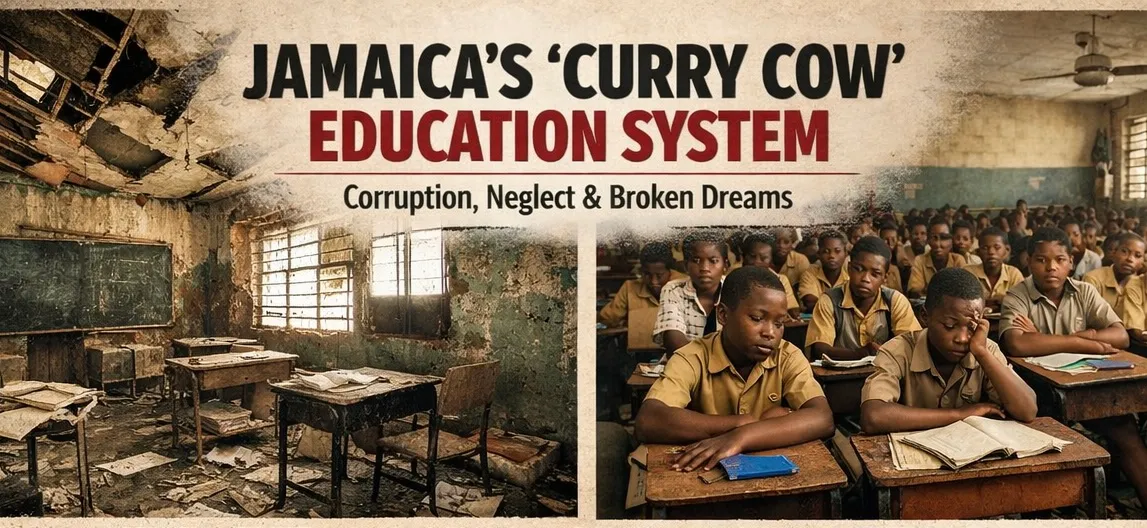
Jamaica’s Curry Cow Education: A Cultural Sovereignty Fight!


 ...Jamaica’s education crisis is rooted in corruption, colonial legacy, and mental slavery. Cultural sovereignty demands radical transformation now!
“We must emancipate ourselves from mental slavery, for though others might free the body, none but ourselves can free the mind.”

Marcus Garvey


By Norris R. McDonald, Sulfabittas News Syndicate @sulfabittas

There are few tragedies more enduring than an education system that systematically undermines the very people it claims to uplift. In Jamaica, where more than 11 per cent of the adult population remains functionally illiterate, the consequence is not merely academic failure but the slow burial of potential.

Generations of children are being consigned to low-wage labour, economic uncertainty, destroyed hopes and dreams.


Jamaica's political and business elites thrive while the education system collape.

This crisis is not the result of scarce resources; it is the outcome of deliberate mismanagement, corruption, and a colonial mind-set that continues to shape the Jamaican society.

ELITISM, CULTURAL AND SOCIAL STAGNATION
Let us be clear: this is not accidental. From its inception, Jamaica’s education system was designed to serve a narrow elite while disciplining the majority into obedience. As Professor Errol Miller and others have long demonstrated, decades of reform have failed to close the gap between the privileged and the working class.

Instead, schooling continues to socialize our children into submission – training them to fit neatly into a global capitalist order where their creativity is extracted, their  labour exploited, and their aspirations contained.

My friends, the government’s endless parade of trust-deficit “solutions” has produced little beyond press releases and procurement contracts while fostering corruption.

Despite high enrollment, a United Nations study has found Jamaica’s learning outcomes to be dangerously weak. Only about 20 per cent of teachers are university graduates, and digital literacy remains an afterthought in a world increasingly defined by technology. Meanwhile, we continue to fund a system that reliably produces illiteracy, underemployment, and social stagnation.

We are producing societies with perpetual deep rooted poverty and social stagnation. 


A CORRUPTION-DRIVEN ‘CURRY COW’ EDUCATION SYSTEM

The crisis in education cannot be separated from Jamaica’s broader political economy. Government officials routinely cite budget constraints to justify chronic underinvestment, but this explanation collapses under scrutiny.


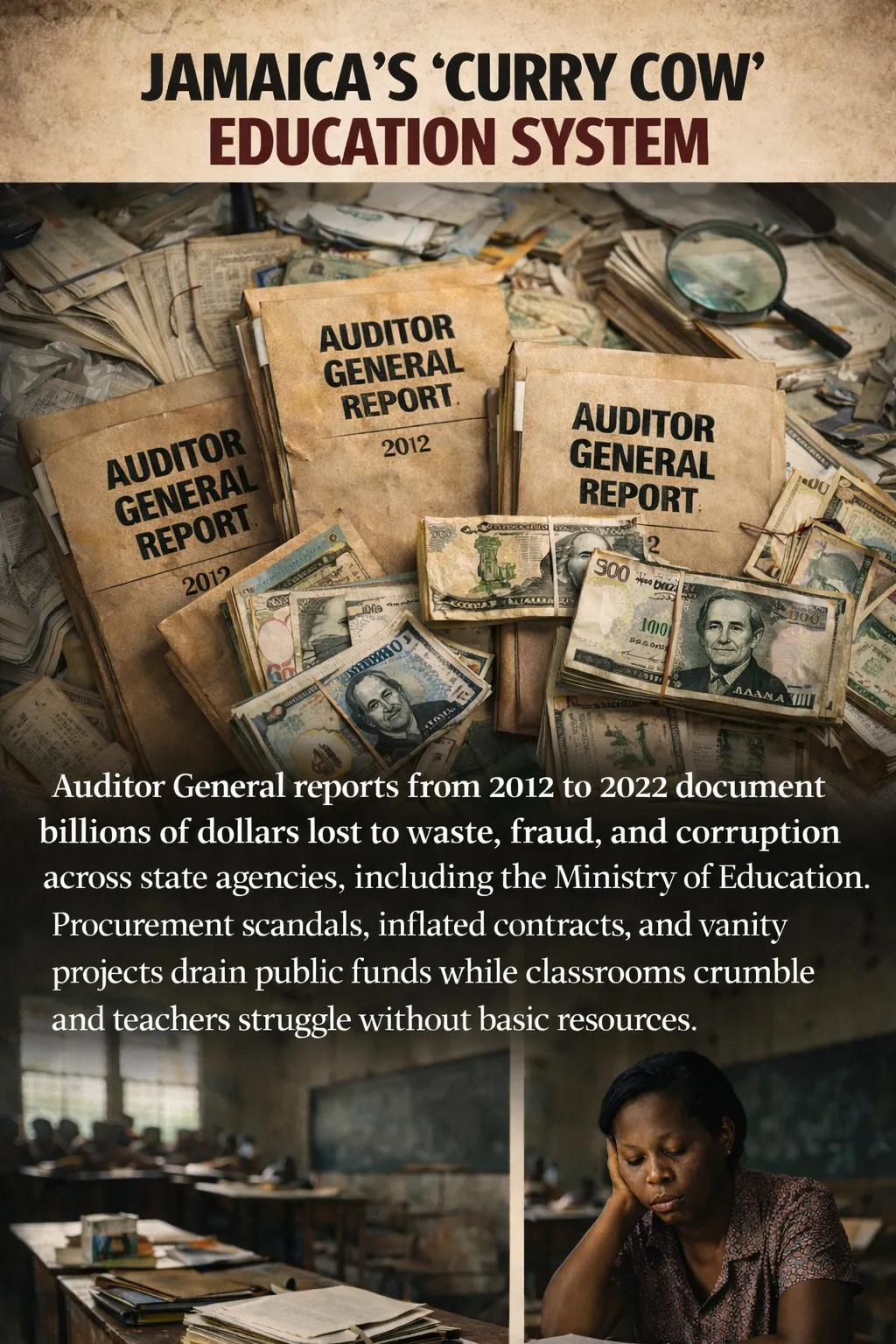
The problem is not scarcity; it is priority. Auditor General reports from 2012 to 2023 document billions of dollars lost to waste, fraud, and corruption across state agencies, including the Ministry of Education. Procurement scandals, inflated contracts, and vanity projects drain public funds while classrooms crumble and teachers struggle without basic resources.


This is a government that finds ample money for foreign travel, consultants and ceremonial excess, yet pleads poverty when asked to invest in children. Education has become a “curry cow” – a lucrative feeding trough for political insiders rather than a vehicle for national development.


Despite the rhetoric of reform, outcomes worsen, inequality deepens, and the gulf between elite institutions and underfunded public schools grows ever wider.


At its core, this dysfunction reflects the logic of capitalism itself. Jamaica’s education system is not designed to cultivate critical thinkers, innovators, or self-determining citizens. It is engineered to produce a compliant workforce for a global economy that thrives on cheap labour and limited horizons. Western capitalist nations preach meritocracy and opportunity, yet actively structure education to reproduce class hierarchies at home and dependency abroad. Minds are not developed; they are conditioned.


CUBA: A GOOD EXAMPLE AMERICA LOVES TO HATE


Contrast this with Cuba – a country relentlessly demonized and economically strangled by the United States and its allies for over six decades.


Despite an unforgiving blockade and material scarcity, Cuba has built one of the most successful education systems in the world, boasting near-universal literacy and strong outcomes across disciplines. This achievement is not rooted in excess wealth or cutting-edge technology but in political will.


Cuba consistently invests between 10 and 12 per cent of its GDP in education, prioritizing human development over profit. Education is treated as a public good and a cornerstone of sovereignty, not a commodity to be rationed or privatized.


In doing so, Cuba exposes the lie at the heart of capitalist ideology: that poverty, rather than policy, explains educational failure.


While Jamaica squanders public funds and bends to the dictates of international financial institutions, Cuba has built an education system that equips its people to participate in – and challenge – the global knowledge economy. Its success is not incidental; it represents a direct challenge to Jamaica’s, British inspired, colonial education system.


Cuba's educational system and outranks all developed, industrialized nations, including America. 


CREATIVITY, CULTURE AND NATIONAL SOVEREIGNTY


Cuba’s educational philosophy extends beyond the classroom. Creativity, culture, and community are central pillars of national development. Jamaica, by contrast, commodifies its cultural output — reggae, dancehall, athletics – without embedding creative education or economic ownership into the school system. 


Our global cultural influence has not translated into broad-based empowerment because we have failed to integrate creativity, technology, and heritage into a coherent educational strategy.


If Cuba can produce world-class doctors, engineers, scientists, and artists under siege, Jamaica has no excuse beyond political cowardice and ideological capture. Instead of cultivating national talent, our leaders defer to the IMF and their foreign masters. They therefore, wittingly or unwittingly, appear servile; pushing and implement policies that destroy the lives of black poor people and the middle class.


Loans replace vision, technical assistance substitutes for structural change.


My dear friends, what Jamaica requires is not more debt or donor-driven reform, but a fundamental reorientation of education toward cultural liberation rather than compliance.


EDUCATION MUST EMPOWER AND LIBERATE MINDS


Jamaica’s national hero Marcus Garvey warned that “a people without the knowledge of their past history, origin and culture is like a tree without roots.” He further reminded us that ‘we must emancipate ourselves from mental slaver to free our mind.’


Jamaica’s education system – shaped by colonial residue and enforced today through IMF and World Bank austerity – does precisely the opposite. It uproots African memory while institutionalizing mental captivity, training children for dependency rather than sovereignty.


Until education restores historical consciousness and rejects imperial supervision, political independence remains hollow, and liberation deferred.


Breaking free from colonialism and imperialism demands an education system rooted in black consciousness, cultural confidence, and national pride. Knowledge must be understood not merely as a means of survival, but as a weapon of resistance. 


We must abolish this education system that perpetuates ignorance, illiteracy and economic servitude and cultural enslavement.


Education must reflect the society it serves. 


If we desire a Jamaica that is just, sovereign, and self-determining, we must begin by transforming how and why we educate. 


Anything less is an endorsement of the cultural imperialist status quo.


That is the bitta truth.


[Norris R. McDonald is an author, economic journalist, political analyst, and respiratory therapist. Send feed back  miaminorris@yahoo.com.]