
Sulfabittas News reports on major Caribbean and global political developments affecting Jamaica and the wider region...

[As dedollarization accelerates, the United States is pivoting toward cryptocurrency and deregulated stablecoins as an alternative financial architecture. In this deeply researched investigation, economic journalist Norris R. McDonald applies world-systems theory to examine how Trump-era crypto policy may externalize systemic risk onto small nations whose reserves, pensions, and remittances remain tied to U.S. financial institutions. The article raises urgent questions about financial sovereignty, digital corruption, and whether America’s Bitcoin gamble could quietly expropriate the wealth of vulnerable states].
By Norris R. McDonald, DIJ
Economic Journalist
Sulfabittas News Syndicate

A Tectonic Shift in the Global Financial Order
“We are in a tectonic era of political-economic crisis that world-systems theorist Immanuel Wallerstein would have called the terminal phase of international capitalism.”
This observation is no longer confined to academic debate. It now describes the lived reality of the global economy.
Across the world, governments are quietly preparing for a future beyond U.S. dollar dominance. Dedollarization—once dismissed as rhetorical defiance—has become a structural trend. Nations are reducing dollar exposure, developing alternative payment systems, and insulating themselves from financial shocks originating in the United States.
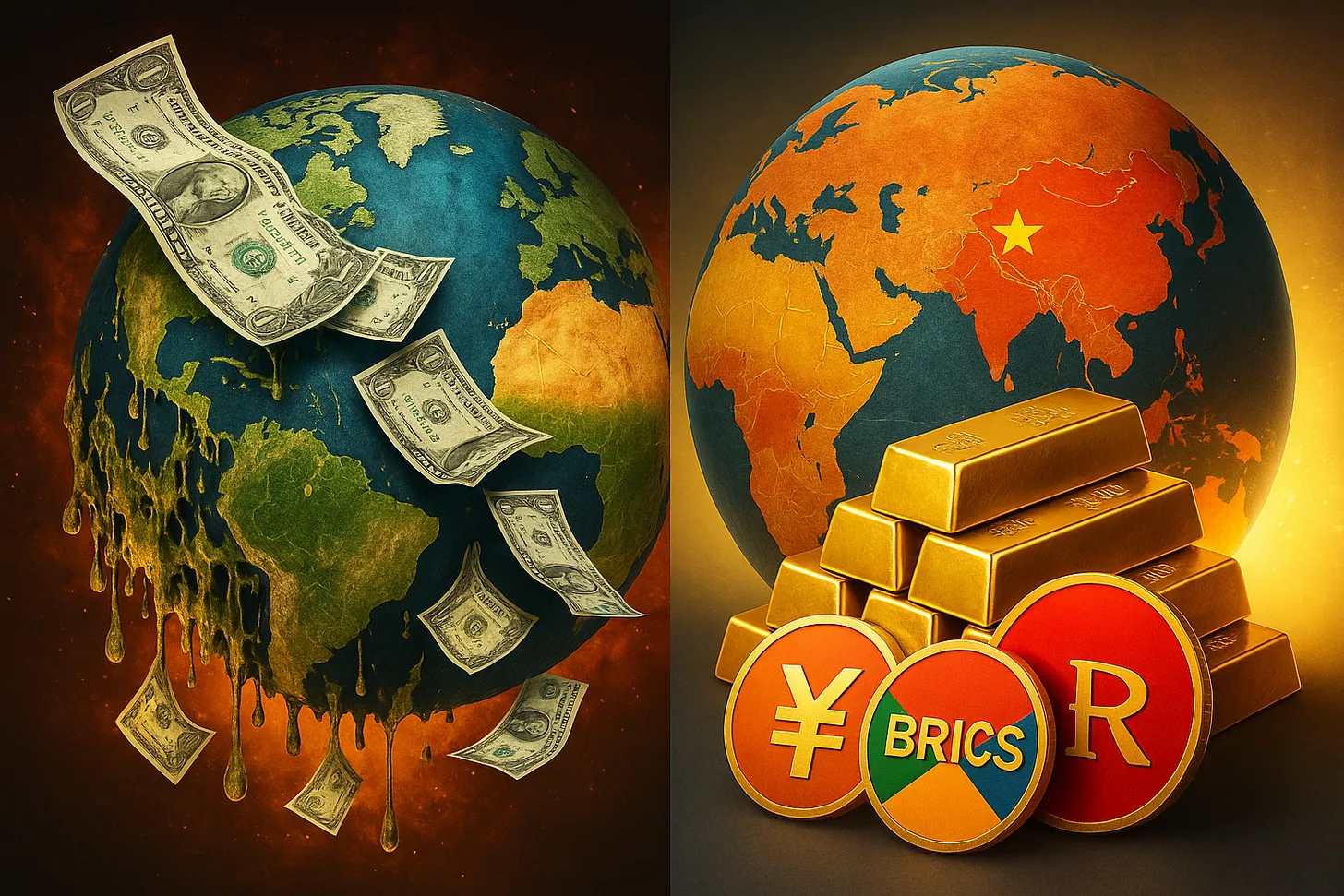
Simultaneously, the United States appears to be making a dramatic and dangerous pivot: embracing cryptocurrency as a geopolitical and fiscal escape route from mounting debt, industrial decline, and eroding monetary credibility.
At the center of this gamble is Donald Trump’s aggressive promotion of crypto assets, stablecoins, and deregulated digital finance—what critics increasingly describe as crypto imperialism.
For small nations whose reserves, pensions, remittances, and sovereign assets are tied to U.S.-linked financial institutions, a critical question emerges: could America’s crypto experiment place their national wealth at risk?
Trump’s Crypto Casino and the GENIUS Act
By legitimizing cryptocurrency as a strategic financial asset, the United States is constructing a parallel monetary system operating outside traditional central-bank oversight and long-standing regulatory safeguards.
Recent policy shifts confirm this direction. U.S. agencies, including the Federal Deposit Insurance Corporation, now permit banks to engage in crypto-related activities without prior regulatory approval, relying instead on assurances that institutions are “managing the risks.”
History suggests otherwise. When risk is privatized and losses are socialized, the most vulnerable actors—small states and working populations—pay first.
Countries with reserves and deposits held in U.S. banks, including Jamaica and other CARICOM economies, have no binding guarantees that their funds are insulated from crypto exposure, stablecoin volatility, or speculative digital instruments embedded in balance sheets.
The same exposure applies to diaspora populations whose retirement savings and remittances pass through U.S. financial intermediaries.
Conflict of Interest and Digital Corruption
Senator Elizabeth Warren has issued some of the strongest warnings, sharply criticizing Trump-era crypto legislation, particularly the so-called GENIUS Act. She has described it as a framework designed not to protect consumers or financial stability, but to enable corruption and self-enrichment.

Warren accused Trump of turning the White House into “a crypto casino where the house always wins—and the house is called Trump.”
Reports indicate that Trump-linked entities now control more than US$2 billion in crypto assets, swelling to as much as US$6 billion during market surges. Through World Liberty Financial, the Trump family has launched digital tokens such as WLFI and the USD1 stablecoin. Meme coins bearing the Trump name generate millions in speculative revenue, while First Lady Melania Trump has introduced her own $MELANIA token.
This convergence of political authority and speculative finance represents a profound governance failure with global consequences.
Crypto Imperialism and the Export of Crisis
Since the 1970s, the United States has struggled to maintain broad-based industrial growth. In its place, financialization—debt expansion, asset bubbles, and speculative instruments—has become the dominant survival strategy.
Immanuel Wallerstein’s world-systems theory offers a critical lens. In The Decline of American Power and World-Systems Analysis, Wallerstein argued that hegemonic powers in decline increasingly rely on fictitious capital while exporting instability to peripheral economies.
He identified key features of this terminal phase: declining productive capacity, explosive speculative finance, systemic crisis externalization, and the erosion of institutional legitimacy.
Cryptocurrency fits this pattern precisely.
 |
After the 2007–2008 financial crisis, Washington injected unprecedented liquidity into the global system. Crypto emerged as a shadow monetary sphere absorbing surplus capital disconnected from real economic activity. Today, with U.S. national debt exceeding US$37 trillion, digital assets offer an illusion of escape—inflating away obligations rather than confronting them.
Let's take a moment to digest this. This is not recovery. It is deferment through risk transfer.
Gambling Tokens Versus Productive Economies
American cryptocurrencies are speculative gambling instruments. They are created from thin air, powered by enormous electricity consumption, and backed primarily by hype, branding, and political endorsement.
They do not produce food, infrastructure, medicine, or sustainable employment.
By contrast, China’s digital yuan is backed by approximately US$3.3 trillion in foreign reserves derived from manufacturing, trade surpluses, and real production. One system is rooted in material output; the other in financial abstraction.
This distinction matters profoundly for nations deciding where to hold their reserves.
Dedollarization Is Accelerating
Around the world, states are building financial firewalls against U.S. instability. China expands the Belt and Road Initiative and promotes yuan-based trade. Russia, India, Saudi Arabia, and Qatar increasingly transact in national currencies. BRICS explores gold-backed settlement mechanisms. Africa develops the Pan-African Payment and Settlement System.
These developments reflect a growing consensus: dependence on a volatile, financialised dollar system is no longer safe.
America’s turn to crypto may delay its decline, but it cannot prevent it.
Jamaica, CARICOM, and Hidden Exposure
For Jamaica and the wider CARICOM region, vulnerability is structural. Foreign reserves remain overwhelmingly dollar-denominated. Remittances—essential to household survival—flow through U.S.-regulated banks now authorized to engage in crypto activities with limited oversight.
 |
| Developing countries like Jamaica, U.S. dollar financial reserves are at risk. |
Jamaica’s Jam-Dex represents cautious domestic digital innovation, but it does not protect reserves held abroad. If U.S. institutions integrate stablecoins or crypto-linked assets into treasury operations, Caribbean economies could face exposure without transparency or consent.
This is not conjecture. It is a governance blind spot.
Africa, BRICS, and the Search for Monetary Sovereignty
African economies confront a similar dilemma at greater scale. Historically bound to IMF-style debt dependency, many now see alternatives emerging.
China’s US$50 billion pledge following the 9th China–Africa Forum targets poverty eradication, food security, healthcare, and disease control. Russia, now the world’s fourth-largest economy by purchasing power parity, has expanded development and health cooperation across Africa despite sanctions.
 |
| IMF debt-driven policies worsens poverty in poor nations. |
The rise of BRICS and its New Development Bank complements these shifts. With a capital base of US$100 billion, the NDB finances sustainable development projects without the ideological conditionalities attached to traditional Western lending.
Projects such as Egypt’s Suez Wind Energy initiative and multiple South African community investments demonstrate finance linked to production rather than speculation.
A Call for Transparency Before the Crash
Small nations cannot afford blind trust. Parliamentary inquiries into foreign reserve exposure, full disclosure of crypto-linked financial instruments, and robust public oversight are now essential.
Waiting for collapse before asking hard questions would be catastrophic.
Conclusion: A Global South Warning, Not a U.S. Debate
Senator Elizabeth Warren’s critique of Trump-era crypto policy is not a narrow fight over U.S. regulation—it is a warning to the world. Her condemnation of the GENIUS Act as a vehicle for deregulation, corruption, and self-enrichment exposes a deeper threat: the conversion of the U.S.-anchored financial system into a lightly governed crypto experiment whose risks are exported far beyond American borders. When the issuer of the world’s reserve currency abandons restraint, every nation tied to that system inherits the consequences.
For small and developing states, the exposure is concrete. Many Global South economies hold a majority of their foreign reserves in U.S. dollars or dollar-denominated institutions. Caribbean and African nations rely heavily on remittances—often exceeding 15–25 percent of GDP—channeled through U.S. banks and payment platforms. Pension funds, sovereign deposits, and correspondent banking relationships are deeply embedded in the American financial system. As U.S. banks and intermediaries are allowed to integrate crypto assets and stablecoins with minimal oversight, these external funds risk being indirectly entangled in volatile digital instruments, without consent, transparency, or legal protection.
Warren’s warning is ultimately about power without accountability. A deregulated crypto regime allows U.S. political and financial elites to privatize gains while externalizing losses—replicating imperial extraction in digital form. Small nations did not choose America’s crypto pivot, yet their reserves may be used to stabilize a speculative system designed to offset U.S. decline.
Dedollarization, in this context, is not rebellion—it is self-defense. The Global South must treat America’s crypto gamble as a systemic risk signal. Diversifying reserves, strengthening regional payment systems, demanding transparency from correspondent banks, and accelerating monetary cooperation are no longer optional strategies. They are survival imperatives. What is deregulated in Washington will not stay in Washington. If unchecked, it will be paid for in the balance sheets of the world’s most vulnerable economies.
The time to act is now. That’s the Bitta Truth.
References
Immanuel Wallerstein, World-Systems Analysis
Immanuel Wallerstein, The Decline of American Power
Giovanni Arrighi, The Long Twentieth Century
Samir Amin, Imperialism and Unequal Development
Norris R. McDonald, Crypto Imperialism: Can America’s Bitcoin Gamble Rob Small Nations’ Reserves?
[Norris R McDonald is an Author, and economic journalist with Sulfabittas News Syndicate whose work focuses on global finance, political economy, and the systemic vulnerabilities facing small states in a shifting world order.

No comments:
Post a Comment