 |
| After over 60 years of the failed Cuban economic embargo that imposed hardships on the Cuban people, many of whom are Black, U.S. President Donald Trump has tightened the squeeze, with a tough Oil Embargo under his New Monroe Doctrine. Experts now fear severe hunger affecting the Cuban people. But China has steeped in to send 60,000 tons of rice, while Mexico has sent 800 tons of food. Russian President Vladimir Putin has pledge to send oil, gas and other petroleum products... READ MORE BELOW! |
— Amid President Donald Trump Tightened Economic Blockade, Blackouts, Possible Humanitarian Disaster and Global Tensions Rise!
By Norris R McDonald --- @sulfabittas News

Since 2001 over1000 American students have received fully paid scholarships medicine at the Latin American School of Medicine, in Cuba, have graduated and are practicing medicine in U.S. poverty-stricken neighborhoods.
Cuba also sent doctors to help America after, Hurricane Katerina. Cuba have also provided economic and educational and health assistance to over 70 Latin American, Caribbean and Asian countries. [See Video] 👉
THE NEW MONROE DOCTRINE, STRIPPED BARE
But, if you were to listen President Donald Trump and his Marco Rubio, there is nothing good about Cuba. irrational policy towards Cuba became even more extreme in early 2026, President Donald Trump escalated the United States’ long-running economic war against Cuba into a more direct and dangerous phase: an energy blockade designed to cripple daily life.
Following kidnapping Venezuelan President Nicolás Maduro and Firts Lady, Cilia Flores, Washington moved swiftly to sever Havana’s primary oil lifeline, combining tanker interdictions, secondary tariffs on third-party suppliers, and expanded financial and travel restrictions. The practical effect is not abstract pressure on a state. It is the deliberate constriction of electricity, transport, water, healthcare, and food systems.
 |
| A Cuban citizen holds up her Ration Book which allowed them to survive 60 years of the U.S. coercive economic embargo. |
This approach represents a qualitative shift. For decades, sanctions were justified as tools to encourage reform. The present strategy is closer to infrastructural suffocation. By targeting fuel—the foundation of modern society—the policy transforms economic coercion into a public-health emergency. Rolling blackouts lasting up to 20 hours a day, airports unable to refuel aircraft, rationed public transport, and overstretched hospitals are not unfortunate side effects. They are predictable outcomes of an energy chokehold.
CUBA’S GLOBAL MEDICAL LEGACY
Cuba enters this moment with deep historical memory. For more than sixty years under embargo, Cubans have survived through ration books, informal networks, and a culture of collective endurance. Limited market-oriented reforms allowed farmers and small vendors to sell produce directly, easing certain bottlenecks and improving availability in some areas. Yet structural vulnerability remained. Low wages, import dependence, and restricted access to foreign currency never disappeared. The embargo shaped an economy permanently operating under constraint.
What complicates the dominant narrative is that Cuba, despite this siege, built internationally recognized capacities in education, science, and healthcare. Literacy rates, doctor-to-patient ratios, and public health outcomes rival those of far wealthier countries. Cuban medical brigades have worked in more than seventy nations, providing disaster response, rural healthcare, and epidemic control across Africa, the Caribbean, Latin America, and parts of Asia.

After Hurricane Katrina, Havana offered medical scholarships to low-income American students. During the COVID-19 crisis, Cuban doctors treated patients in Italy at a moment when European health systems were buckling. Cuba also gave 7 outstanding students of Miami University fully paid scholarships to study in their universities.
These facts matter because they expose the moral contradiction at the heart of Western policy. Countries that accepted Cuban medical solidarity during emergencies now politically align with Washington’s continued strangulation of the Cuban economy. The issue is not whether one supports Cuba’s political system. It is whether collective punishment of civilians is an acceptable instrument of statecraft.
BRICS, CUBA AND SOUTH-SOUTH COOPERATION
Cuba’s geopolitical position has also evolved. On January 1, 2025, Cuba officially joined BRICS as a “partner country,” not a full member. That distinction matters. Partner status does not grant full voting power or integration into all BRICS financial mechanisms, but it does signal political alignment and access to expanding South-South cooperation frameworks.
For Havana, the designation represents an attempt to diversify economic relationships beyond Western-dominated financial systems and reduce vulnerability to unilateral sanctions.
 |
| Cuba's agricultural reform had created budding farmer's markets that supplied some food to households. |
BRICS partnership offers symbolic legitimacy and potential economic channels, including development financing discussions and alternative trade arrangements. However, it is not an immediate shield against fuel shortages or secondary sanctions. Cuba’s structural challenges—limited hard currency reserves, energy import dependence, and restricted access to global capital markets—remain acute.
What BRICS partnership does provide is strategic optionality. China and Russia, both central actors within BRICS, have already signaled willingness to supply food and fuel assistance. Such support underscores a broader geopolitical shift in which economic coercion is increasingly contested by emerging power blocs. The island’s survival, therefore, is no longer a purely bilateral matter between Washington and Havana; it sits within a widening contest over the architecture of global economic order.
THE HUMANITARIAN DIMENSION
Yet even with new partnerships, the humanitarian dimension remains immediate. Diplomatic designations and multilateral alignments cannot power hospital generators overnight. Energy remains the pressure point, and until supply stabilizes, Cuba’s domestic strain will continue.
History offers little support for this theory. Sanctions more reliably entrench hardship than produce liberalization. They weaken civilian institutions, concentrate economic power in informal or black-market networks, and deepen distrust between societies and external actors. They do not build democratic culture. They corrode it.
The central question, therefore, is not whether sanctions exert pressure—they clearly do. The question is whether any foreign policy that depends on hospitals going dark, children going hungry, and families living by candlelight can claim moral legitimacy.
Cuba’s future should be determined by Cubans. Not by Washington’s Treasury Department, not by geopolitical rivalries, and not by the strategic convenience of great powers.
That is the Bitta Truth.
*********************
Author: Norris R. McDonald, DIJ
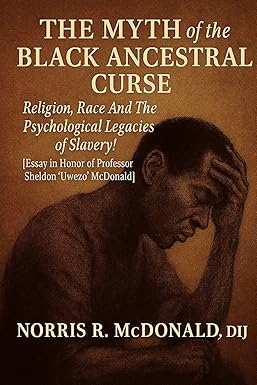
- Deconstructing the Curse of Ham, Colonial Lies, and the Struggle for Black Liberation
- How Slavery, Religion, and Myth Created Generational Trauma—and How We Break Free
- Unmasking Religious Racism and Reclaiming Black Spiritual Freedom
For centuries, Black people have been told that their suffering is divine punishment—ordained by God and passed down through a mythical “ancestral curse.”
In this powerful, eye-opening work, Norris R. McDonald, DIJ, dismantles one of the most enduring and damaging lies in Christian history: the so-called Curse of Ham. From the hymnals of colonial churches to the halls of modern academia, this myth has been used to justify slavery, colonization, and systemic racism.

No comments:
Post a Comment